What Is an AI Agency? Definition, Services and Costs 2026

By :
Ali
August 13, 2026
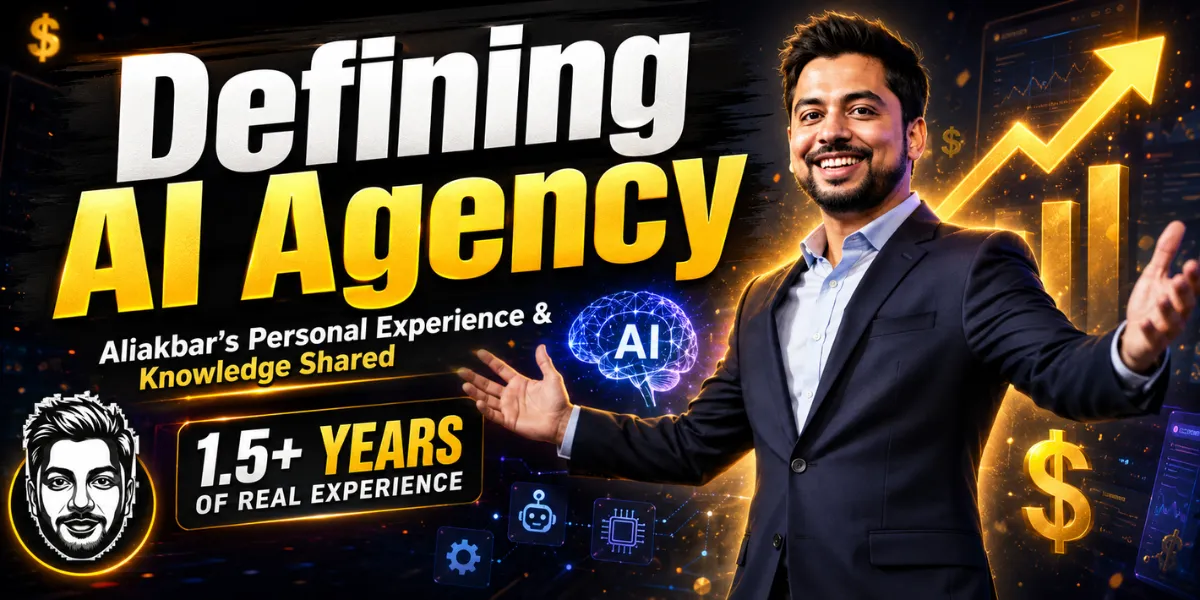
Most people writing about AI agencies have never run one.
I have. Eighteen months, a team of 35, and $18,000 a month of my own money going into AI tooling before a single client invoice is raised.
That last number is the one that separates a real answer from a content-marketing answer.
So here’s the straight version. What an AI agency actually is, what it isn’t, what the economics look like, and the cases where hiring one is a waste of your money.
⚡ Quick Answer
An AI agency is a services business that builds and operates AI systems for clients, rather than selling AI-assisted labour by the hour.
The distinction is the whole thing. A traditional agency that uses ChatGPT to write faster is still a traditional agency. An AI agency delivers a system that keeps running after the retainer call ends.
Three tests separate the two:
- Does the deliverable run without a human?
A campaign brief is labour. A pipeline that pulls live market data, drafts, checks and publishes is a system. - Does the client own the system or rent the output?
Real AI agencies hand over infrastructure. - Does cost per unit fall as volume rises?
Human agencies scale linearly. Systems don’t.
If the answer to all three is no, you’re looking at an agency that changed its homepage.
The Straight Definition
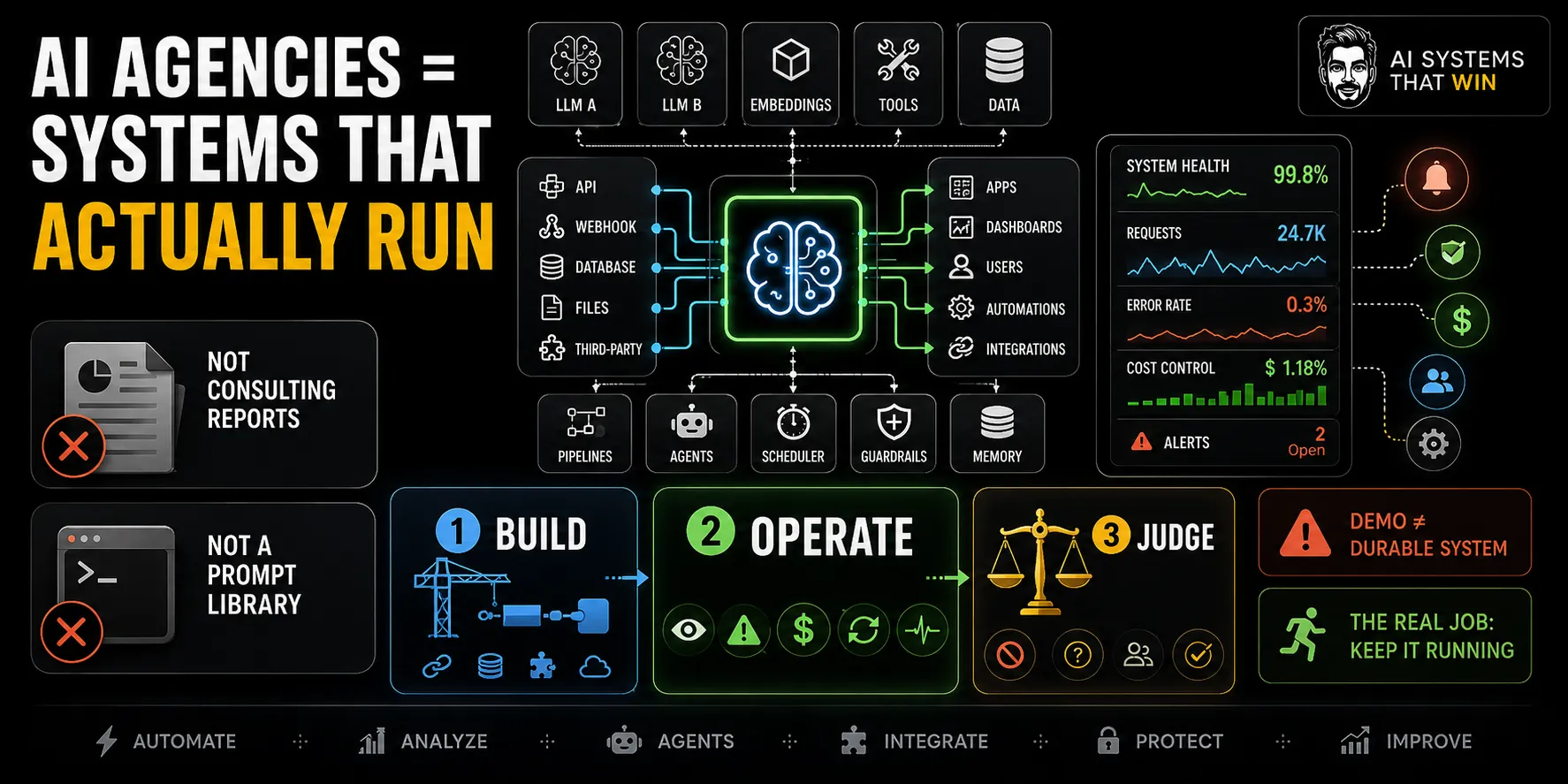
An AI agency designs, builds and runs automated systems using frontier AI models, on behalf of clients who don’t have the internal capability to do it themselves.
Not consultants who write reports about AI. Not a marketing agency with a prompt library. A team that ships working infrastructure and stays responsible for it when it breaks.
The word doing the work is operate. Anyone can build a demo. The hard part is the system still running correctly in month nine, when the source site changed its HTML and the model started hallucinating into your client’s blog.
Three functions, in the order they matter:
- Build. Pipelines, agents, connectors, internal tools. The plumbing between a model and a business.
- Operate. Monitoring, error handling, cost control, model migration when a better one ships. This is the part nobody sells and everybody needs.
- Judge. Deciding what shouldn’t be automated. That’s a service too, and the most underrated one.
What an AI Agency Is Not
The category got crowded fast, so the negative definition is more useful than the positive one.
Here’s the uncomfortable number that proves the point. MIT’s NANDA initiative studied enterprise generative AI deployments and found about 95% of organisations were getting zero measurable return on their generative AI investment. Only around 5% of integrated pilots were extracting real value.
McKinsey found the same shape from the other direction. More than 80% of companies reported no tangible EBIT impact from generative AI, with only 17% attributing 5% or more of earnings to it.
I’m putting those numbers in section two, not the footnotes. Any AI agency that won’t show you the failure statistics is selling, not advising.
Why This Category Exists Now
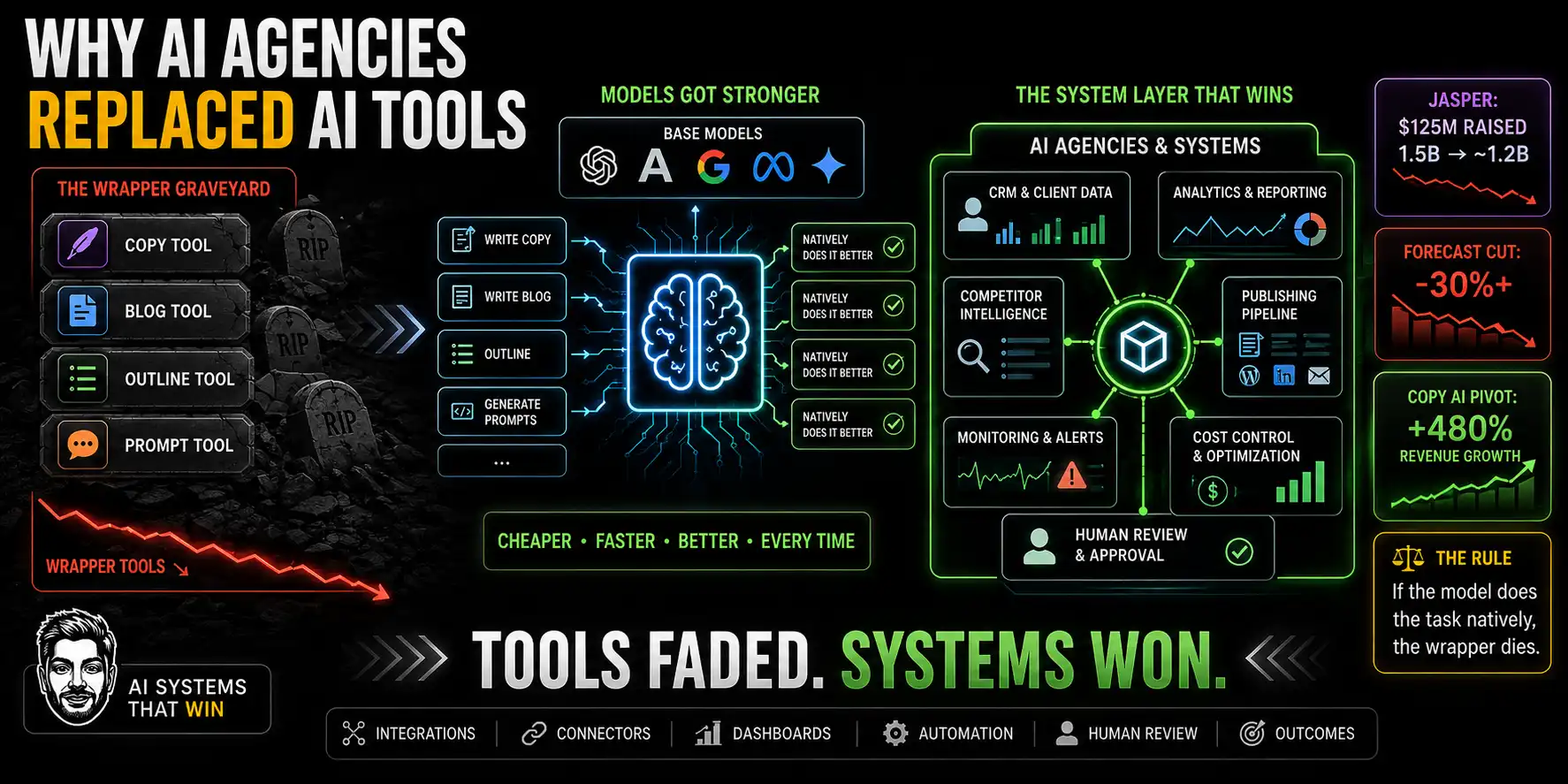
The AI agency didn’t emerge because AI got good. It emerged because the tool layer collapsed.
Think back to 2023. There was a standalone SaaS product for every task.
Jasper for copy. Copy.ai for outlines. Writesonic for blog posts. Dozens more.
Each one a thin wrapper over an OpenAI API call, charging a monthly subscription for the wrapper.
Jasper raised $125 million at a $1.5 billion valuation in October 2022, roughly eighteen months after founding. By July 2023 it was cutting roles. Reporting from The Information later put its internal valuation cut at around 20%, to roughly $1.2 billion, with revenue forecasts cut by at least 30%.
What killed the category wasn’t competition. It was the base models getting good enough that the wrapper stopped adding value.
Watch what the survivor did. Copy.ai abandoned AI writing entirely, repositioned as a go-to-market automation platform, and reported 480% revenue growth in 2024.

The company itself said the pivot came after GPT-4’s capabilities emerged. Writesonic made a similar move, repositioning around generative engine optimisation.
The pattern is clear enough to state as a rule. When a model can do the task natively, the tool that wrapped that task dies. Nobody pays a subscription for a feature their existing subscription already includes.
So what survived? Not tools. Systems.
Connecting Claude to your CRM, your analytics, your competitor data and your publishing pipeline is not a feature any model ships. Neither is the error handling, the cost control or the human review gate. That’s an integration problem, and integration problems need people.
That’s the gap an AI agency fills. Everyone is drowning in tools and starving for a stack.
The Market, 2023 to 2029
Numbers, with sources, because this section usually gets written from imagination.
| Metric | Figure | Source |
|---|---|---|
| Worldwide AI spending, 2025 | $1,764.9 billion | Gartner, May 2026 |
| Worldwide AI spending, 2026 | $2,595.7 billion, up 47% | Gartner, May 2026 |
| Worldwide AI spending, 2027 forecast | $3,493.4 billion | Gartner, May 2026 |
| AI models segment, 2026 | $32.6 billion, up 110% year on year | Gartner, May 2026 |
| Agentic AI share of IT spending by 2029 | Over 26%, exceeding $1.3 trillion | IDC, Aug 2025 |
| Corporate AI investment, 2024 → 2025 | $253.02bn → $581.69bn, up 129.9% | Stanford HAI AI Index 2026 |
| US vs China private AI investment, 2025 | $285.88bn vs $12.41bn | Stanford HAI AI Index 2026 |
Adoption moved just as fast. McKinsey’s State of AI survey gives a clean four-year series:
| Year | Using AI in ≥1 function | Regularly using generative AI |
|---|---|---|
| 2023 | 55% | 33% |
| Early 2024 | 72% | 65% |
| 2025 (fielded 2024) | 78% | 71% |
| Late 2025 | 88% | — |
Adoption went from a majority to near-universal in three years. Measured returns did not follow.
That gap between 88% adoption and roughly 95% zero-return is the entire commercial case for an AI agency. Companies bought the tools. Almost nobody built the systems.
Gartner separately estimates $234 billion of enterprise application software spend is exposed to agentic disruption through 2030 — around 20% of enterprise SaaS.
I’d treat all long-range forecasts as directional. Grand View Research and Precedence Research differ by roughly 2x on the same 2025 market size.
That tells you how much modelling assumption is baked in. The direction is reliable. The decimal places aren’t.
AI Agency Services: What Actually Gets Delivered
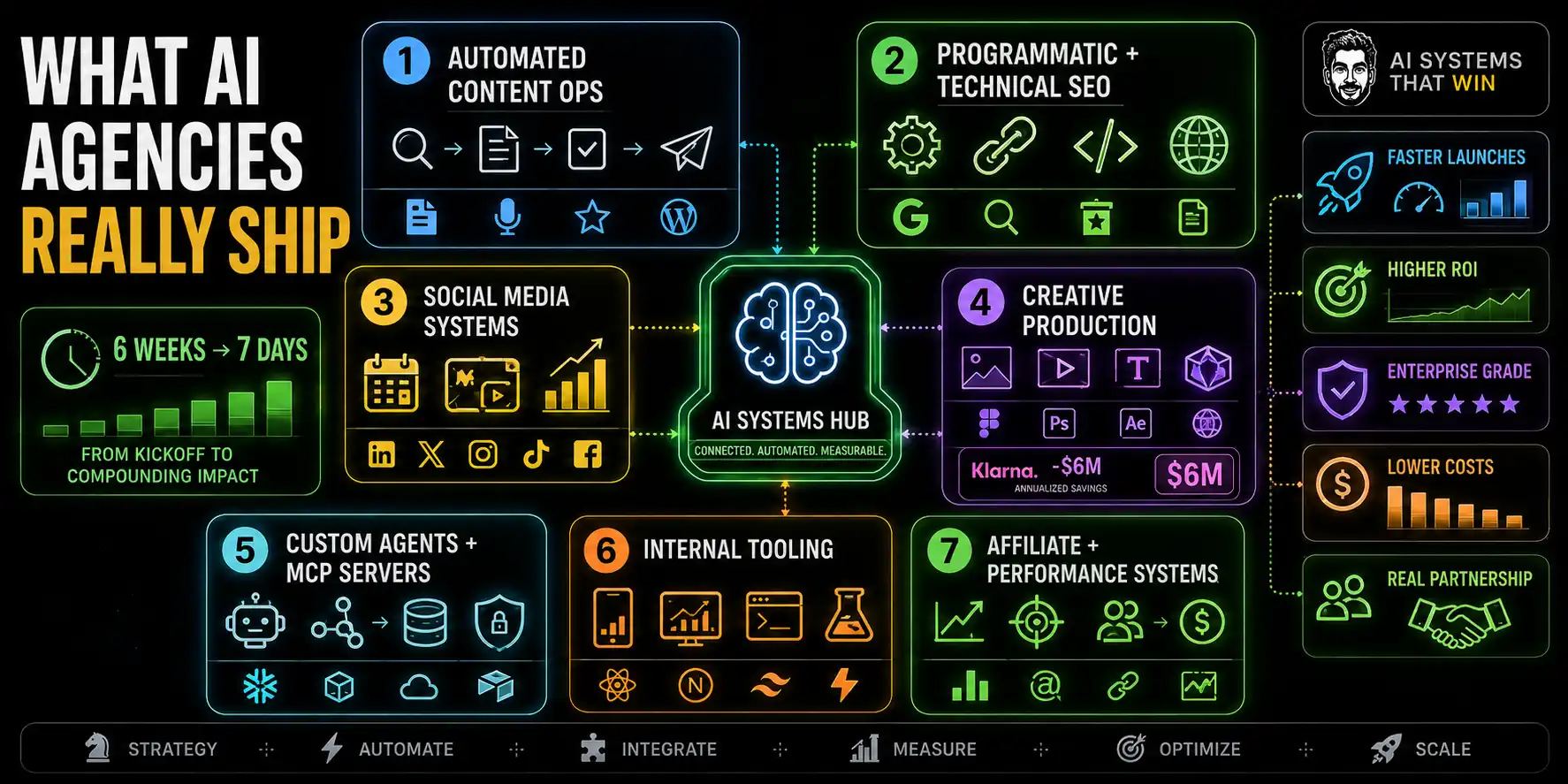
Here’s what we actually build. I’m listing what ships, not a services page.
- Automated content operations. Live market data pulled with Firecrawl and Apify actors, competitor gap analysis, drafting against a brand voice profile, human review gate, publish. The research layer matters more than the writing layer, which is why generic AI content fails.
- Programmatic and technical SEO. Keyword clustering at thousands of terms, internal link mapping, schema generation, GEO work so the client gets cited in AI Overviews and ChatGPT answers. This is where AI SEO agency work has actually moved — from ranking pages to being the source an assistant quotes.
- Social media systems. This is the one people underestimate. A model with your brand guidelines, your research and direct API access can run a social operation end to end, with no third-party scheduling tool in the middle. Claude or GPT via API, n8n for orchestration, platform APIs for publishing.
- Creative production. Image and video generation for e-commerce brands — product imagery, ad variants, localised creative. Klarna published real numbers on this: image production costs down about $6 million annualised, and cycle time from six weeks to seven days.
- Custom agents and MCP servers. Connecting a model directly to a client’s own database or product. I wrote a separate build log on how to build an MCP server without writing code.
- Internal tooling. Android and iOS apps, landing pages, dashboards, e-commerce test harnesses. Not consumer-grade products — internal tools that used to need a contractor and three weeks.
- Affiliate and performance systems. Offer monitoring, competitor creative tracking, automated lead scoring. I documented one of these in full in my B2B lead generation build log.
Notice what’s missing. Strategy decks. Brand workshops.
I’m not saying those have no value. They’re a different business, and you shouldn’t pay AI agency rates for them.
The AI Agency Business Model
The AI agency business model differs from a traditional agency in one structural way: the cost curve.
A traditional agency sells hours. Twice the output needs roughly twice the people. Margin is capped by headcount, which is why holding companies are shrinking.
An AI agency sells systems. Building costs a lot up front. Running costs very little, and running cost per unit falls as volume rises.
| Traditional agency | AI agency | |
|---|---|---|
| Priced on | Hours, retainer, headcount | Build fee plus operating retainer |
| Cost curve | Linear with volume | High fixed, low marginal |
| Margin at 10x volume | Roughly flat | Expands sharply |
| Main risk | Utilisation | System failure and model drift |
| Client owns | Deliverables | Infrastructure |
| Breaks when | Staff leave | Nobody maintains the pipeline |
Sir Martin Sorrell put the consequence more bluntly than I would.
The published numbers back him. WPP’s revenue fell 8.1% to £13.55 billion in 2025, with headcount dropping from 108,044 to 98,655, and another fall to about 97,000 by mid-2026. Omnicom announced 4,000 direct layoffs after acquiring IPG. CEO John Wren said agentic AI “reduces the need for what was previously manual work.”
That’s the industry restructuring in real time. An AI agency isn’t a trend riding that wave. It’s what the wave leaves behind.
Why we don’t take every client. We have a team of 40 and finite bandwidth. We take on clients who want systems built, not clients who want to say they’re using AI.
That’s not exclusivity as a sales tactic. A system-building engagement that the client won’t maintain or use is a failure with a nicer invoice attached.

The Stack We Actually Run
No affiliate link changes this list. This is what’s running.
| Layer | What we use | Why |
|---|---|---|
| Reasoning | Claude Opus 5, Claude Sonnet, GPT-5.6 | Long-horizon agentic work, tool use |
| Model routing | OpenRouter | One API across 400+ models, 5.5% markup |
| Web data | Firecrawl | Arbitrary pages into clean markdown |
| Structured scraping | Apify | Prebuilt actors for known sources |
| Orchestration | n8n | Auditable scheduling, deterministic branching |
| Research | GenSpark, Claude research | Second-brain layer, broad sweeps |
| Storage | Sheets, Supabase | Human override matters more than elegance |
On image and video models, the landscape moves monthly and I’d rather describe the approach than publish a ranking that expires. For product and ad creative we route between the current frontier image models and video models depending on the brief. The right answer changes often enough that committing to one vendor is the mistake.
OpenRouter deserves a specific mention. It charges a 5.5% markup over provider pricing with no subscription, and it’s now running around 100 trillion tokens a month across roughly 8 million users. It raised $113 million at a $1.3 billion valuation in May 2026.
For an agency, the value isn’t the markup. It’s that switching models when a better one ships becomes a config change rather than a migration project.
The Chinese Model Question, Honestly
You’ll read that Chinese models have caught up and cost a fraction of American ones. Half of that is true. I checked, because I pay these bills.

On capability. As of early August 2026, the highest-ranked Chinese model on LMArena’s text leaderboard is Alibaba’s qwen3.8-max at #5, scoring 1496 against 1509 for the top model. That’s a 10-point Elo gap. Only three Chinese models sit in the top 25.
The more careful measure is the Epoch Capability Index. It puts the leading Chinese model roughly 4 to 5 months behind the US frontier looking backward, around 8.6 months looking forward. Stanford’s AI Index reported the top-model gap narrowing to about 2.7% on Arena scores, down from 17.5 to 31.6 percentage points in May 2023.
So: closed dramatically, not closed entirely.
On price, the popular claim is now half wrong. Here’s what these actually cost per million tokens:
| Model | Input | Output |
|---|---|---|
| GLM-4.7-FlashX (Z.ai) | $0.07 | $0.40 |
| GPT-5.6-luna (OpenAI) | $0.10 | $0.60 |
| DeepSeek V4-Flash | $0.14 | $0.28 |
| DeepSeek V4-Pro | $0.435 | $0.87 |
| Qwen3.7-Max (Alibaba) | $1.475 | $4.425 |
| GPT-5.6-sol (OpenAI) | $2.50 | $15.00 |
| Kimi K3 (Moonshot) | $3.00 | $15.00 |
| Claude Sonnet 4.6 | $3.00 | $15.00 |
| Claude Opus 5 | $5.00 | $25.00 |
Read the top and the bottom of that table separately.
At the budget tier the Chinese advantage is real but no longer unique. DeepSeek V4-Pro against Claude Opus 5 is roughly 11x cheaper on input and 29x on output. That’s a genuine, large gap. But OpenAI’s GPT-5.6-luna at $0.10 input now undercuts DeepSeek V4-Flash, and GLM-4.7-FlashX is cheaper still.
At the frontier the claim is simply false. Kimi K3 costs $3 input and $15 output — identical to Claude Sonnet 4.6, and more expensive on input than GPT-5.6-sol. The idea that Chinese frontier models are cheap stopped being true in 2026.
Two caveats worth knowing before you build a cost model on this. DeepSeek has publicly stated it plans a significant price increase. And Anthropic’s newer models use a tokenizer producing roughly 30% more tokens for the same text. Headline per-token prices understate real cost by about a third.
What we actually do: route by task. Cheap models for classification, extraction and bulk transformation. Frontier models for anything where being wrong is expensive. That routing decision is worth more than any single model choice.
What It Costs, and When AI Is More Expensive
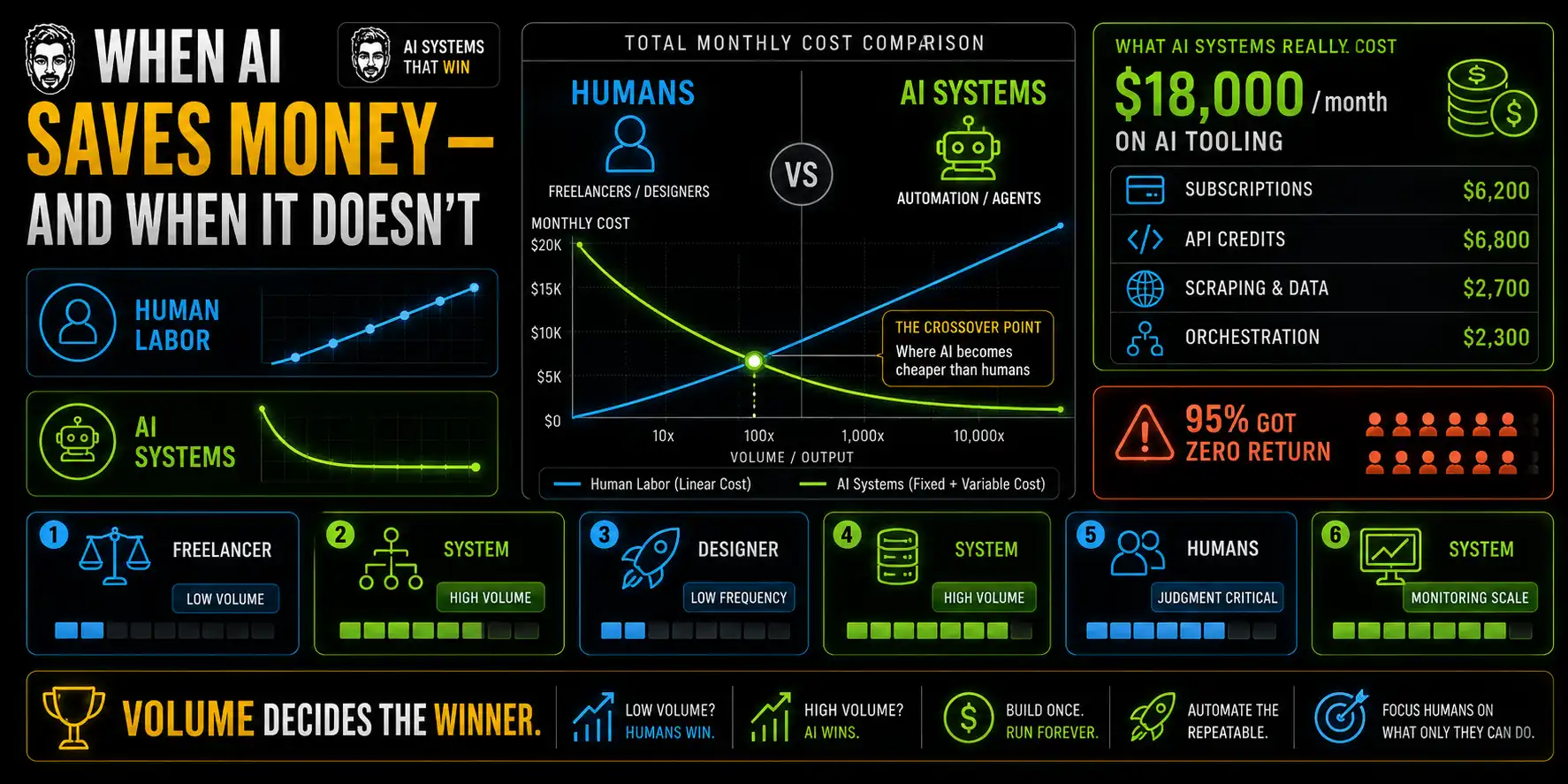
I spend $18,000 a month on AI tooling across the network before any client work is billed. Subscriptions, API credits, scraping infrastructure, orchestration.
That number only makes sense at volume. This is the part the category lies about.
The honest version of the cost-saving claim.
Content operations and creative production are where the savings are largest, because both are volume problems with clear quality gates.
I won’t publish a blanket “95% cheaper” figure. It’s only true for particular workloads at particular volumes, and stating it flat is exactly the guru behaviour this site argues against.
When AI is more expensive — say it plainly. If you need 10 keywords researched a month, an AI system costs more than a freelancer. Building it, testing it and maintaining it dwarfs the labour it replaces.
The crossover is volume. Building a system is expensive and roughly fixed.
Running it is cheap and scales sublinearly. Human labour is cheap to start and scales linearly forever.
| Scenario | Cheaper option |
|---|---|
| 10 articles a month, one-off | Freelancer |
| 1,000 keywords a month, ongoing | System |
| One ad creative set per quarter | Designer |
| 400 localised ad variants monthly | System |
| Bespoke brand strategy | Humans |
| Daily competitor monitoring across 50 sites | System |
Anyone who tells you AI is always cheaper hasn’t cost a small engagement. The MIT finding — 95% getting zero return — is mostly this mistake at scale.
The Ethics Line
This section costs me business and it stays in.
There’s a large grey market attached to this category. Scraping sites that forbid it. Cloning competitor apps.
Generating fake reviews. Spinning content at volume to game search. Impersonating people in ad creative.
All of it is technically easy now. That’s exactly why the line matters.
Where we draw it. We respect robots directives and terms of service on scraping. We don’t clone products. We don’t generate reviews or testimonials. AI-assisted creative gets disclosed where the platform requires it. Client data doesn’t cross into training or into another client’s system.
There’s demand-side evidence this is commercially correct, not just morally. Gartner found 78% of consumers rate explicit labelling of AI-generated content as very important or their most important trust factor.
The practical risk. Grey-hat automation works until a platform changes one rule. Then you lose the account, the client, and the system you built. I’ve watched people lose a fifteen-year-old ad account to a scraping shortcut that saved them a week.
An AI agency that won’t tell you what it refuses to do is telling you something.
What the People Building This Say
Worth reading the range rather than the headline, because the people closest to it disagree sharply.
Amodei and Huang can’t both be right. I lean toward Huang on timing and Amodei on direction, and I hold that loosely.
Zuckerberg’s quote is the one agency owners should sit with. If the platforms absorb creative, targeting and measurement, the agency work that survives is the work platforms can’t do — systems that span platforms, and judgment about what to build.
Is It a Bubble?
Probably, in the financial markets. Less so in the operating reality. Those are different questions and they keep getting merged.
The institutional warnings are real. The Bank of England noted in July 2026 that the risk of a sharp equity correction remained high. The S&P 500’s cyclically adjusted P/E sat at levels unseen since the dot-com era. The IMF calculated that justifying recent valuations would need S&P 500 and Nasdaq earnings growth near 30% and 35% CAGR respectively — far above analyst expectations.
Ray Dalio agreed in August 2026 with the characterisation of this as the biggest investment bubble in American history. Sundar Pichai told the BBC there were “elements of irrationality” and said no company would be immune, including Google.
Now the other side.
Those are operating facts, not valuations.
Both can be true. Infrastructure gets overbuilt during real transitions — that’s what happened with railways and with fibre. The capital gets destroyed and the infrastructure stays.
What it means practically. If you’re picking an AI agency, pick one whose economics work without cheap capital. If someone’s pitch depends on models getting dramatically cheaper next year, that’s a bet, not a plan.
Who Should Hire an AI Agency, Who Shouldn’t
Don’t hire one if nobody internally will own the system. Every automation we’ve seen fail after handover failed for that reason, not a technical one.
And don’t hire one to say you’re using AI. That’s the most expensive reason on this list and I’ve turned down work for exactly that.
FAQs Related to AI Agency
What is an AI agency in simple terms?
A services business that builds and runs AI-powered systems for clients, rather than selling AI-assisted human labour. The test is whether the deliverable keeps working when nobody is watching it.
What is a AI agency, and is it the same as an AI marketing agency?
They overlap but aren’t identical. An AI marketing agency applies AI to marketing specifically. A generative AI agency focuses on content and creative generation. A full AI agency covers marketing plus internal tooling, data pipelines and custom agents.
What is the difference between an AI agency and a digital marketing agency?
A digital marketing agency sells campaigns and labour, priced by hours or retainer. An AI agency sells systems, priced as a build fee plus an operating retainer. Cost per unit falls with volume for one and stays flat for the other.
What services does an AI agency offer?
Typically automated content operations, technical and programmatic SEO, social media systems, creative generation, custom agents and MCP servers, internal tooling, and data pipelines. The common thread is automation that runs on a schedule.
How much does an AI agency cost?
It varies with system complexity rather than hours. Expect a build fee plus a monthly operating retainer covering monitoring, model costs and maintenance. Ask specifically what happens when the system breaks at 2am — the answer tells you whether you’re buying a system or a demo.
Is an AI agency worth it?
Only at volume. MIT research found roughly 95% of organisations were getting zero measurable return on generative AI, and most of that is small-scale deployments where building cost more than the labour it replaced.
What is an agentic AI agency?
One that builds systems where models take multi-step actions autonomously — calling tools, querying data, making routed decisions — rather than just generating text. Gartner expects over 40% of agentic AI projects to be cancelled by the end of 2027, so ask hard questions about what’s actually in production.
Can I just use ChatGPT or Claude instead of hiring an AI agency?
For individual tasks, yes, and you should. The gap is integration — connecting models to your systems with error handling, cost control and human review gates. That’s engineering work, not prompting.
Do AI agencies replace employees?
In practice they shift work rather than delete it. The measured effect so far is fewer people doing more volume, which is what agency holding company headcount data shows.

Aliakbar Fakhri
The founder of AFFINCO
The Straight Answer
An AI agency is a systems business wearing an agency’s clothes.
The ones worth hiring build infrastructure you own, show you the failure rates alongside the wins, and tell you when your volume is too small to justify them.
The ones to avoid changed their homepage in 2024 and their delivery not at all.
I’ve been running one for eighteen months. It’s harder than the category admits, more valuable than the sceptics allow, and completely wasted on anyone who won’t maintain what gets built.
If you want to know whether your numbers justify a system, book a 30-minute call and I’ll tell you honestly. Sometimes the answer is a freelancer.
Stop buying AI tools. Start building systems.
Evidence beats hype. Every time.
Affiliate Disclosure: This post may contain some affiliate links, which means we may receive a commission if you purchase something that we recommend at no additional cost for you (none whatsoever!)
Similar Posts



About the author:
Aliakbar Fakhri
Founder & CEO of AFFiNCO
I’m Ali, Founder of AFFiNCO, with 15+ years in SEO, paid ads and affiliate marketing.
I run 65+ sites of my own, so every strategy on this blog was tested on my money before it reached you. No guru fluff. Just what actually works.