
beehiiv vs Substack 2026: Pricing, Features, SEO & API Tools

By :
Ali
August 31, 2026
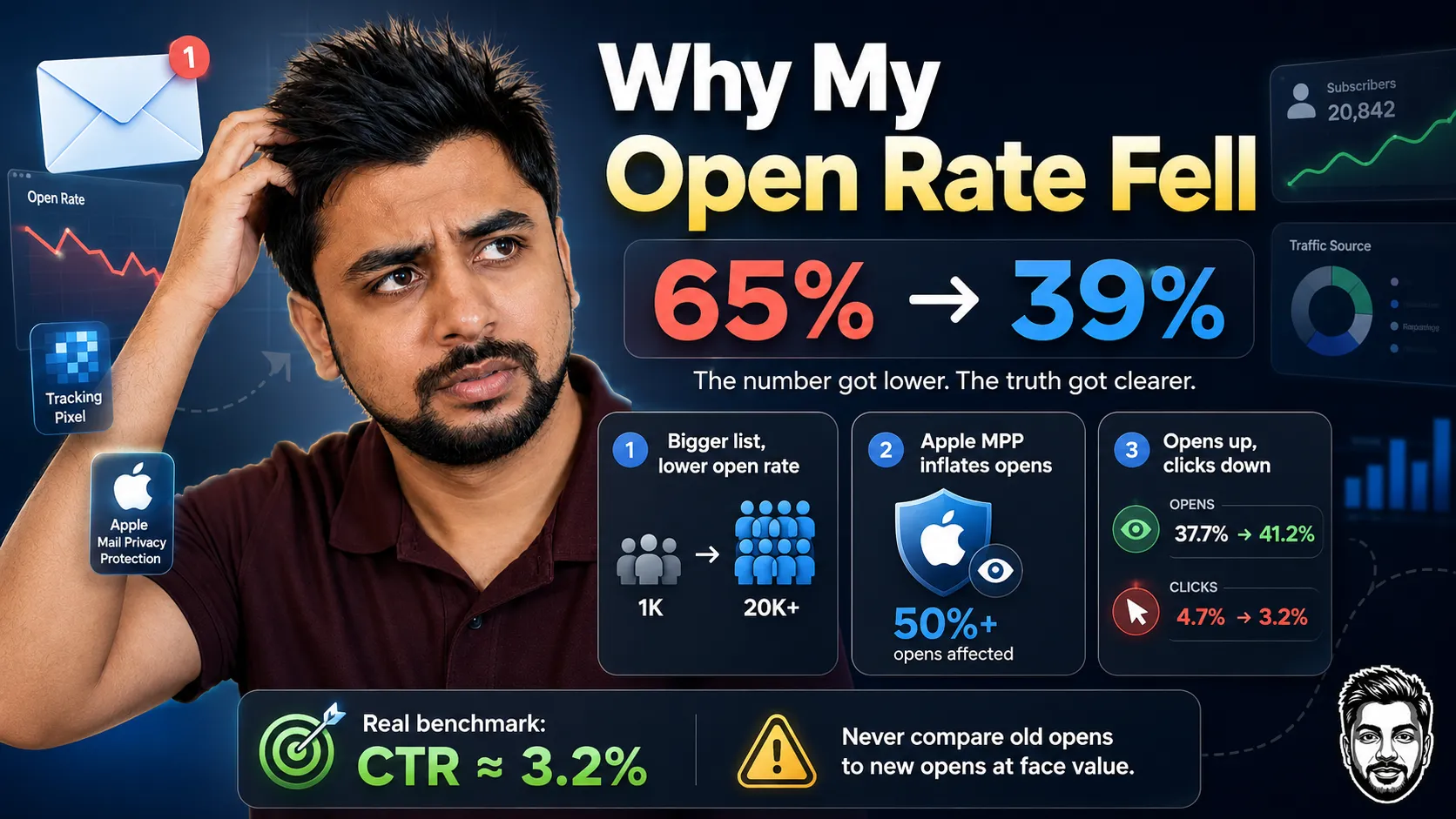
My newsletter open rate used to be 65%. It’s 39% now.
Nothing broke. I’ll explain why that number fell, because it’s the most misunderstood metric in this entire comparison, and both platforms are quietly complicit in the confusion.
I’ve run the AffNinja beehiiv newsletter for two years. I put a separate AI newsletter on Substack to test it properly. Same content discipline, same send cadence, different platforms.


This is what actually separates them — and one difference that decided it outright for me.
✅ Bottom Line Up Front
The Pricing Models Are Not Comparable
People compare beehiiv pricing against Substack pricing and get it wrong, because they aren’t the same kind of price.
Substack has no plans. Publishing is free at any list size. The moment you turn on paid subscriptions, Substack takes 10% of every transaction. Stripe adds 2.9% + $0.30 per transaction, plus a 0.7% recurring billing fee.
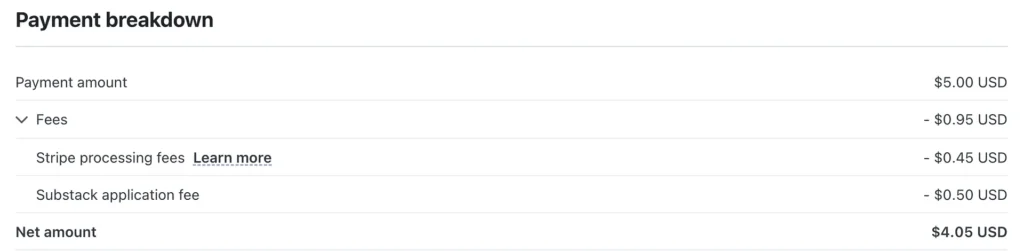
On a $10 monthly subscription that’s about $1.66 gone — roughly 16.6%. On a $100 annual subscription it’s $13.90, about 13.9%.
There’s also a one-time $50 custom domain fee, and minimums of $5/month or $50/year on any paid tier.
beehiiv charges a subscription that scales with your active subscriber count and takes 0% of your revenue.
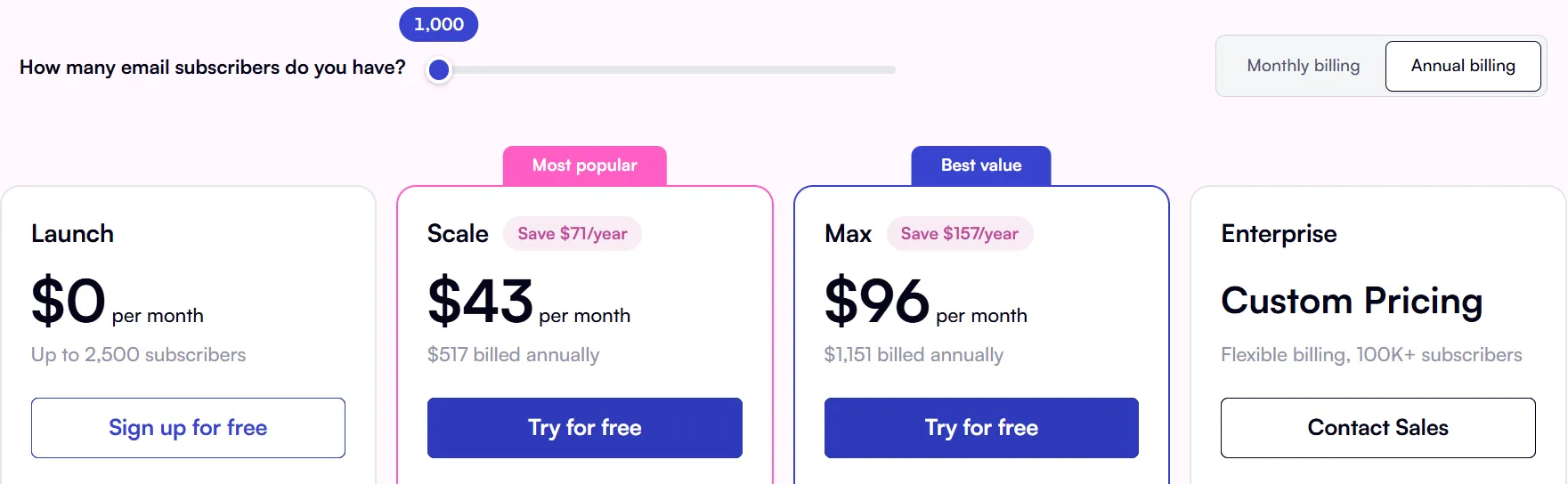
| Subscribers | Scale | Max |
|---|---|---|
| 1,000 | $43 | $96 |
| 2,500 | $61 | $131 |
| 5,000 | $78 | $149 |
| 10,000 | $96 | $193 |
| 25,000 | $149 | $254 |
| 50,000 | $219 | $334 |
| 100,000 | $290 | $404 |
Those are annual-billed, shown monthly. Month-to-month costs more. Above 100,000 subscribers — counted across every publication in your workspace — you’re forced onto Enterprise.
Run the crossover yourself. At 10,000 subscribers, beehiiv Scale costs $96 a month, $1,152 a year. To pay Substack that much you’d need about $8,300 in annual subscription revenue at their ~13.9% annual rate.
If you’re earning more than that, beehiiv is cheaper. If you’re earning less — or nothing — Substack is.
The Free Tiers
Substack’s free tier is more generous, unambiguously. No subscriber cap, no feature gating, and you can monetise on it. That is the model.
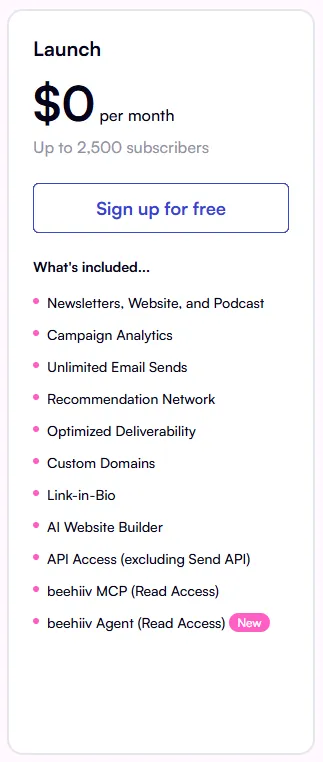
beehiiv’s free Launch plan caps at 2,500 active subscribers. You get unlimited sends, a website, custom domains, podcasts, campaign analytics, the recommendation network, an AI website builder, and read-level API access.
What you don’t get on Launch: paid subscriptions or the Ad Network. Also no automations, A/B testing, advanced analytics, webhooks or teams.
So the honest answer to “is beehiiv free” is: yes, for publishing, up to 2,500 subscribers. No, for making money. Launch is a trial funnel with a generous roof.
Worth flagging a marketing overstatement on beehiiv’s own site. Their features page says they take 0% “on all paid subscription plans,” which reads as though it includes Launch. It doesn’t — Launch has no paid subscriptions at all.
The API Asymmetry That Decided It
This is the section that ended the comparison for me, and almost nobody writes about it.
Every week, my newsletter is drafted, assembled and pushed to beehiiv without me touching the dashboard. Claude does the research and the draft, hits the beehiiv API, creates the post, schedules the send. I review before it goes.
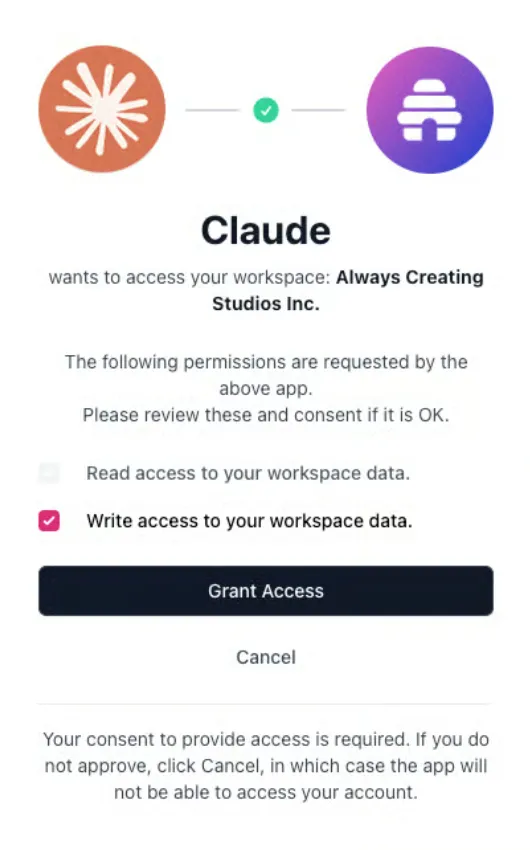
That workflow is possible on exactly one of these two platforms.
beehiiv has a full public write API. The Create Post endpoint accepts title, body content or blocks, subtitle, scheduled time, recipients, email settings, SEO settings, content tags and custom fields. Set status to draft and it saves. Set it to confirmed and it publishes. Pass scheduled_at and it schedules.
It requires the Max plan, which is the real cost of this workflow — $96/month annual-billed at 1,000 subscribers.

They also ship an official MCP server, available to every user including free accounts, with read-only access on free and full content management on paid. There are setup guides for Claude, Claude Code, Cursor and Codex.
One limitation worth knowing: the MCP can create and manage, but publishing must happen in the app or through the REST API. For fully unattended sending you need the API, not the MCP.
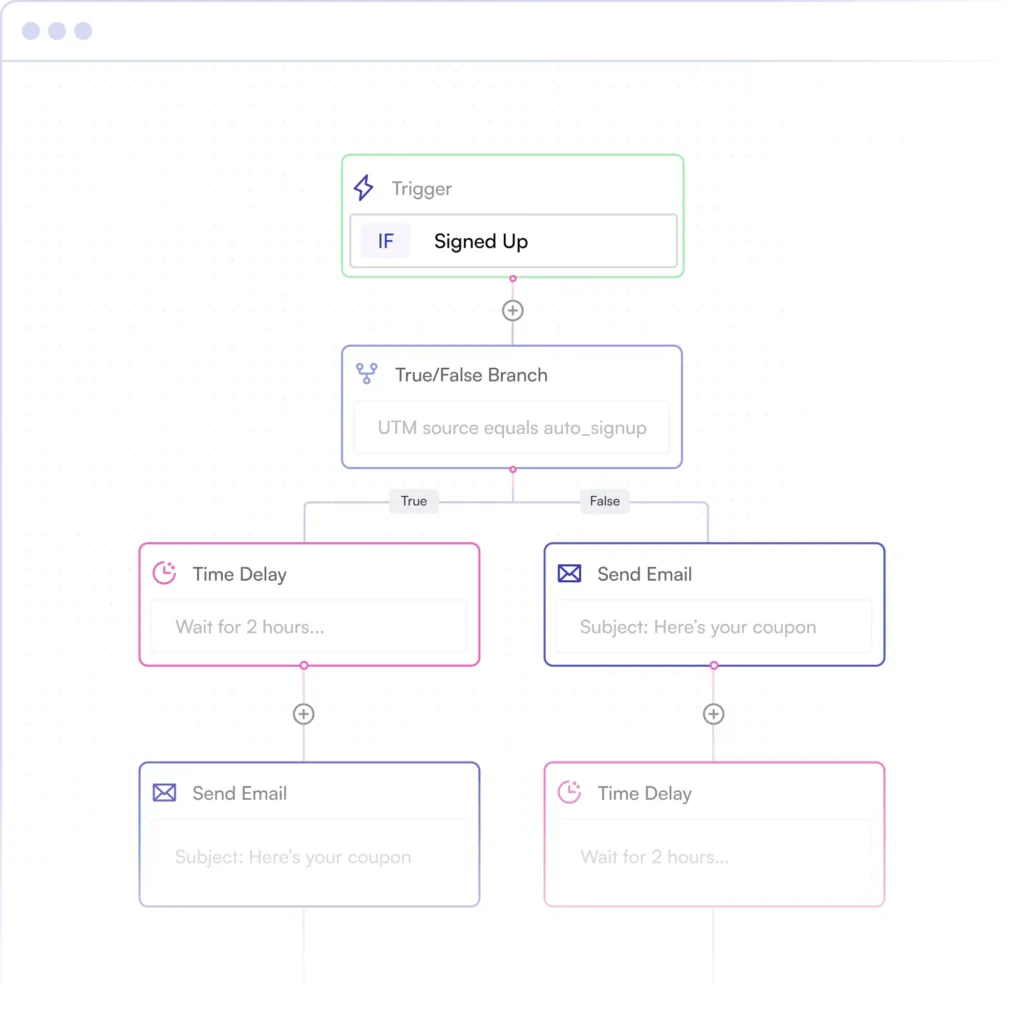
If you already run a beehiiv automation, check it today. On 6 August 2026 beehiiv changed the Create Post default — posts created without an explicit status now save as draft instead of publishing. Sensible change, and it will silently stop any automation that relied on the old behaviour.
Substack’s API cannot publish. Their Developer API terms, effective 8 January 2026, scope it to “publicly available creator information” — names, social URLs, subscriber counts, profile summaries. Permitted uses are display and discovery. Prohibited uses include competing with Substack’s core features.
There’s no official Zapier app, no official MCP server, and no documented endpoint that creates, schedules or sends a post. Unofficial reverse-engineered wrappers exist and sit awkwardly against those terms.
If automated publishing matters to you, this is not a close comparison. It’s the difference between a workflow that exists and one that doesn’t.
Monetisation: Ads, Subscriptions, Recommendations
This is where beehiiv has spent its engineering budget, and it shows.
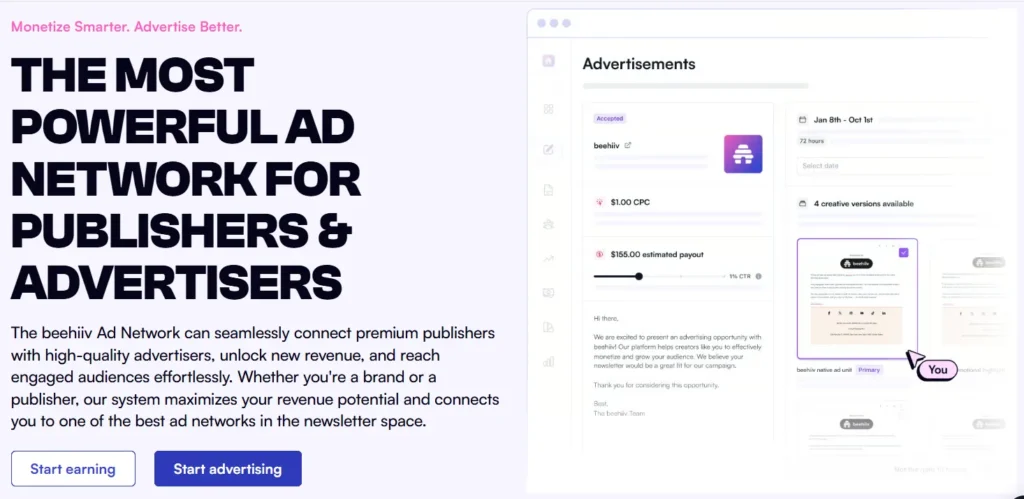
beehiiv Ad Network. Available on Scale and above. You need an active send history and a Stripe Express account. beehiiv vets advertisers, surfaces offers in a dashboard, you accept the ones you want, and they handle tracking and reporting. Payouts land on the 20th of each month.
Two models: CPM, paid per thousand unique opens, and CPC, paid per verified click after bot and bounce filtering.
On earnings, be careful what you believe. beehiiv’s documentation uses “$5 CPM” and “$2 CPC” as worked examples, not as a rate card. There is no published RPM. Anyone quoting you typical beehiiv ad earnings is guessing.
What is published: beehiiv’s cumulative Ad Network creator earnings counter reads about $37.8 million, and their July 2026 release says Ad Network newsletters collectively earn over $1 million monthly.
Finding sponsors manually is a job. Having offers appear in a dashboard, already matched to my audience, is the difference between running a newsletter business and running a sales team.
Finding sponsors manually is a job. Having offers appear in a dashboard, already matched to my audience, is the difference between running a newsletter business and running a sales team.

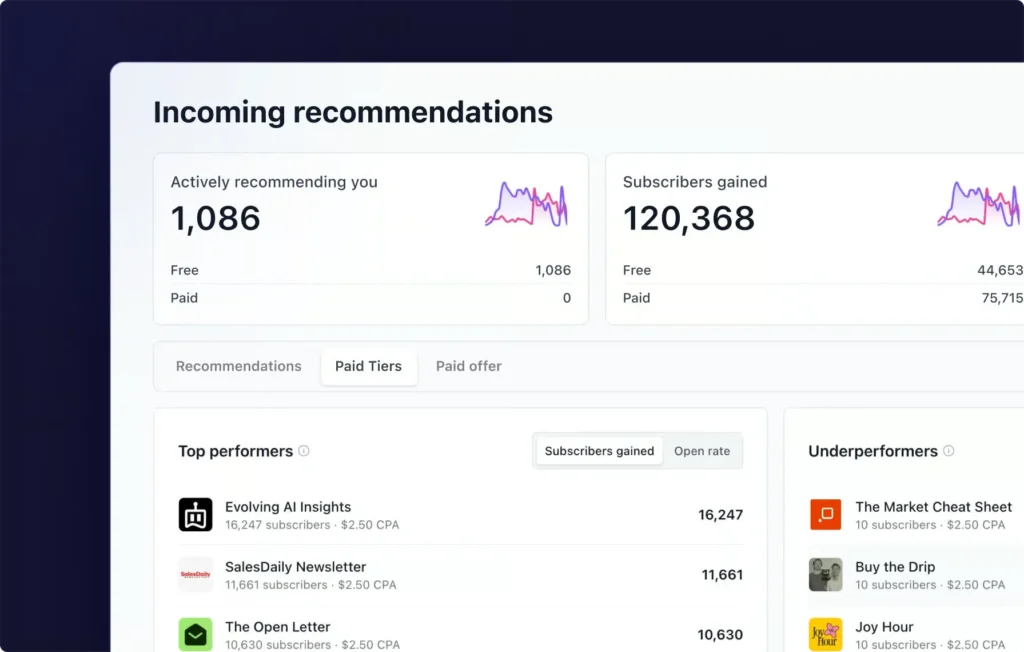
Recommendations, formerly Boosts. As of July 2026, Boosts were renamed paid recommendations and merged with free recommendations. The model is CPA — you pay or earn per verified new subscriber, with geolocation targeting, auto-accept and auto-pause. Email Boosts and Direct Links are retired for new campaigns.
beehiiv reports 30,000+ active publishers in the recommendation network, and that participants grew 2.75x faster than non-participants.
Paid subscriptions: beehiiv takes 0%. Only Stripe’s cut applies. Requires Scale or above.
Substack’s side. Paid subscriptions with founding-member tiers, trials, coupons and gifts. Pledges let readers commit payment details before you monetise, converting when you switch paid on — a genuinely good feature beehiiv has no equivalent for.
And Substack now has ads. They launched a native sponsorship programme on 15 June 2026 with brands including Yahoo Scout, Whatnot, Granola, Balenciaga, T-Mobile, Polymarket and Uber. Substack handles matchmaking and logistics; creators pick partners and keep editorial control.
The eligibility bar is at least 100 paid subscribers. And Substack’s revenue cut on sponsorships has not been disclosed.
That last point matters. beehiiv publishes its ad model. Substack hasn’t published its sponsorship terms.
Deliverability, and What Neither Tells You
beehiiv publishes its sending stack. Substack publishes nothing.
beehiiv runs on Twilio SendGrid. Their case study documents 4.35 billion emails processed, a 1,037% year-on-year volume increase, and a 52% improvement in deliverability rate. They use SendGrid’s Engagement Quality Score to segment shared IP pools, which pushed open rates up 3% in the worst-performing pool.
Platform-wide for 2025: 98.90% delivery rate, 1.48% bounce rate, 0.02% spam complaint rate. Self-reported, but published and specific.
Dedicated IPs are Enterprise-only.
On Substack, I could find no first-party documentation of sending infrastructure, throughput limits, IP management or deliverability at all. No ESP named, no numbers, no dedicated IP option at any level.
That absence is itself the finding. If deliverability is a business risk for you, one platform gives you something to audit and the other gives you nothing.
Why My Open Rate “Fell” From 65% to 39%
Here’s the honest version, and it’s more useful than the number.
My open rate was 65% at its peak. It averages 39% now. Same content, same team, a bigger list.
Three things are happening, and only one of them is about my newsletter.
- First, list size. A 3,000-person list of people who chose you recently will always outperform a 40,000-person list accumulated over years. That’s mathematics, not decline.
- Second, and this is the big one: Apple Mail Privacy Protection. Since iOS 15, Apple pre-fetches remote content — including the tracking pixel — through its proxy servers at delivery, whether or not a human ever opens the email. Every one of those registers as an open.
Litmus reports that over half of all email opens now happen on MPP-affected devices.
That number reframes every open rate you have ever seen.
So a reported open rate is roughly real opens from non-Apple recipients, plus 100% of Apple recipients with MPP on. It has been inflated for years.
- Third, here’s the tell. In beehiiv’s own platform data, open rate rose from 37.67% in 2024 to 41.24% in 2025, while click-through rate fell from 4.74% to 3.23%.
Opens up 3.6 points. Clicks down 1.5 points. Same audience, same year.
That divergence is very hard to explain as real engagement improvement. It’s what progressive MPP adoption looks like.
So my 39% isn’t a decline. It’s roughly the platform average, measured honestly. The 65% was measured in an era when the metric meant something different.
Two practical takeaways. Use click-through rate as your real engagement number — around 3.2% platform-wide is the benchmark to beat. And never compare a beehiiv open rate to a Substack open rate, because Substack changed how it calculates opens to include Substack app inbox receipt and in-app views. Different numerator, different denominator, on top of MPP. Any head-to-head open-rate comparison between these two is methodologically meaningless.
Analytics
Closer than the marketing on either side suggests.
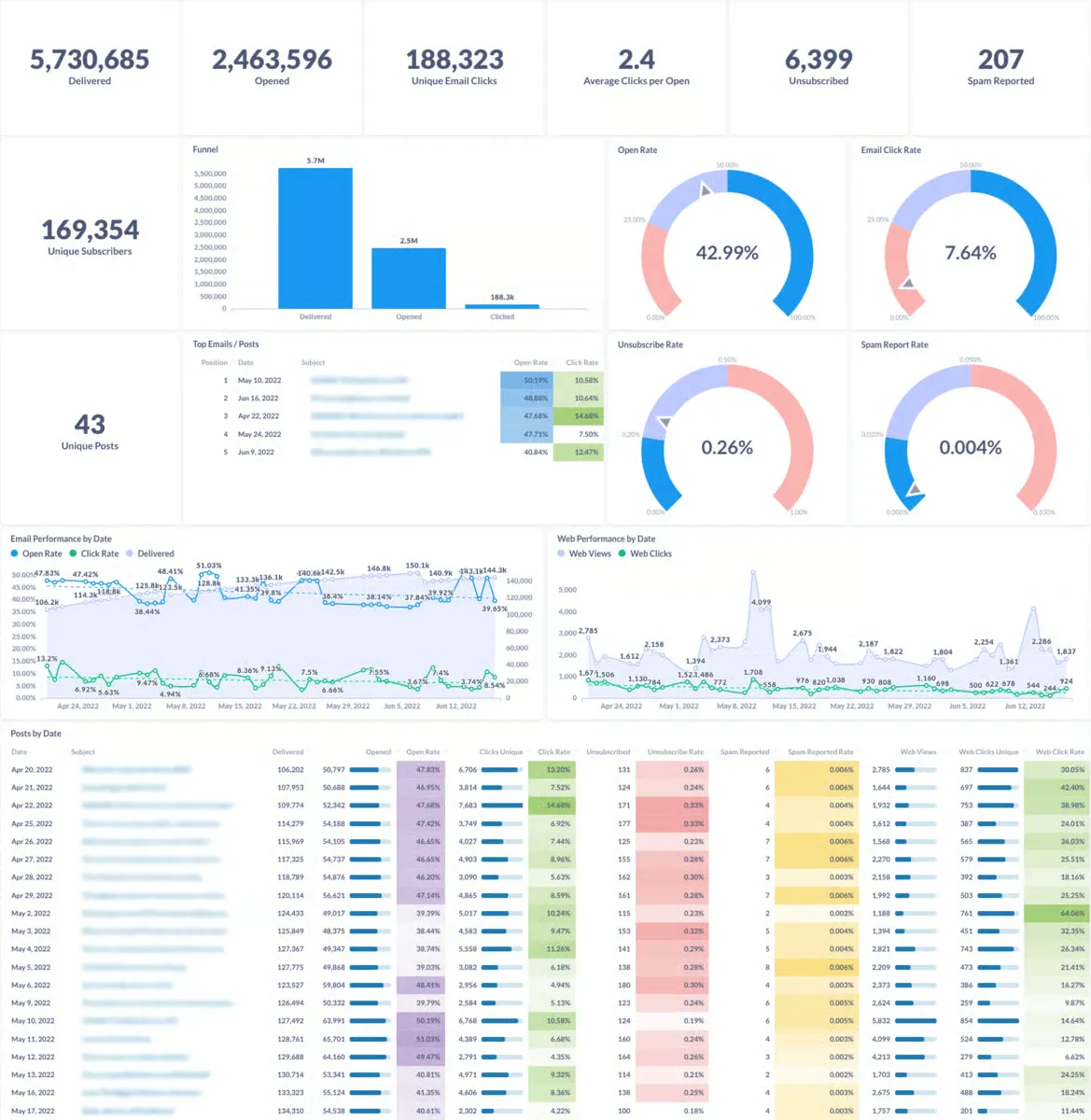
beehiiv’s 3D Analytics splits into a Posts Report and a Subscribers Report. The genuinely useful part is acquisition-source attribution combined with subsequent performance of those cohorts — you can filter by where a subscriber came from and see how that cohort opens and clicks afterwards. That turns ad spend into a measurable cohort ROI question. Scale plan and above.
Substack reports total, paid and free subscriber counts, gross annualised revenue, per-post views across web, email and app, open and delivery rates, clicks and CTR, plus free and paid conversions attributed per post.
It also has paid net growth, cohort analysis and churn dashboards — better native revenue reporting than beehiiv, and better than most people assume.
The split: beehiiv wins on acquisition-cohort ROI and link-level detail. Substack wins on subscription revenue and churn reporting. If your business is paid subscriptions, Substack’s numbers are more directly useful. If your business is growth and sponsorship, beehiiv’s are.
SEO and Owning Your Website
beehiiv is a website platform with a newsletter attached. Substack is a newsletter with a themeable front page.
beehiiv gives you custom domains on every plan including free, plus editable meta titles and descriptions with a live preview. You also get per-page indexability control covering search engines and AI crawlers, automatic XML sitemaps, Open Graph and Twitter card settings, editable slugs and documented Search Console setup.
Cloudflare AI Crawl Control is available on Max and Enterprise with custom domains.
Substack gives you a custom domain for a one-time $50, an SEO title, meta description, editable slug and social preview image. Posts are indexable and Substack handles it for you.
There’s no custom CSS and no arbitrary custom pages. You pick from preset themes, header styles, hero styles and body layouts.
They’re good-looking presets. They’re still presets.
Also worth noting: Substack’s own SEO guide is dated February 2023. In a category where Google has changed substantially, that tells you how much priority it gets.
For SEO-led growth, this isn’t close. beehiiv gives you materially more control.
The Lock-In Nobody Mentions
Both platforms tell you that you own your audience. Both are telling the truth about your list and misleading by omission about the thing that actually matters.
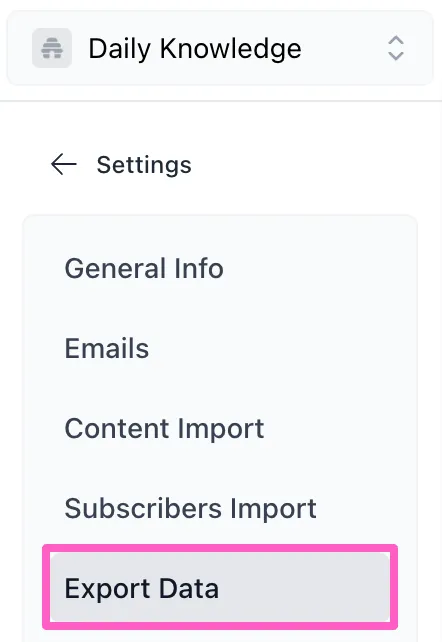
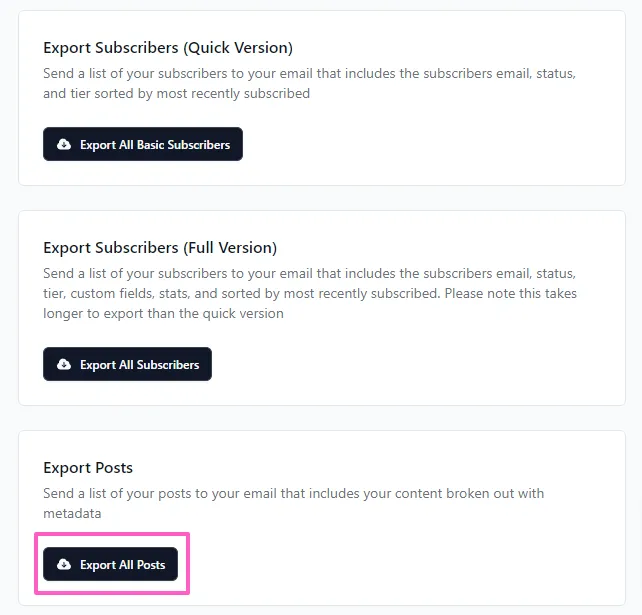
You can export your list from both. beehiiv gives you a quick export or a full export with custom fields and statistics, delivered as CSV with a 24-hour download link. Substack gives you a full CSV including engagement data — though notably you cannot export subscriber names, only email addresses.
You can export your posts from both. beehiiv as CSV. Substack as CSV and HTML.
Neither lets you take your live paid subscriptions.
Substack’s own migration guide is explicit about this in the other direction. Moving to Substack means uploading a CSV of emails and renewal dates, then comping those readers while they re-enter payment details and resubscribe from scratch. You create a new Stripe account on Substack.
The same applies leaving either platform. Your email list is portable, and so is your content.
Your recurring revenue is not. Switching means asking every paying subscriber to re-subscribe, and you will lose some.
That’s partly a Stripe and PCI constraint rather than pure platform policy. The practical effect is identical either way.
So pick carefully at the point you turn on paid subscriptions. That’s the moment the switching cost appears, and neither pricing page mentions it.
Where Substack Is Genuinely Better
I’m recommending beehiiv at the end of this. So let me be straight about what Substack does better, because it’s real.
What I Don’t Like About beehiiv
Who Should Pick Which
FAQs
Can I import my Substack subscribers into beehiiv?
Your email list, yes. Your active paid subscriptions, no — those subscribers have to re-enter payment details and resubscribe. Plan for churn during any migration.
Does beehiiv have a free plan?
Yes, up to 2,500 active subscribers, with unlimited sends, a website and custom domains. You can’t run paid subscriptions or the Ad Network on it.
Which platform is better for SEO?
beehiiv, clearly. Per-page indexability control, AI crawler settings, automatic sitemaps, Search Console setup and white-label on Max. Substack’s SEO controls are basic and its own guide hasn’t been updated since 2023.
How much does Substack really take?
About 16.6% on a $10 monthly subscription and about 13.9% on a $100 annual one, once you add Substack’s 10% to Stripe’s processing and recurring-billing fees.
Can I run ads on Substack now?
Yes, since June 2026, if you have at least 100 paid subscribers. Substack curates the brand partnerships. They haven’t disclosed their revenue share.
Is a 39% open rate bad?
No. beehiiv’s platform average was 41.24% in 2025. Treat anything in the high thirties as normal, and watch click-through rate instead — around 3.2% is the platform benchmark.
Can I use beehiiv with Claude or ChatGPT?
Yes. beehiiv ships an official MCP server with setup guides for Claude, Claude Code, Cursor and Codex. Free accounts get read-only; paid accounts get content creation and management. Actual sending needs the REST API on Max.
What happens to my newsletter if I stop paying beehiiv?
You can export your subscribers and posts as CSV. Your live paid subscription billing doesn’t transfer anywhere, on any platform.

Aliakbar Fakhri
The founder of AFFINCO
The Question That Actually Decides It
Forget the newsletter platform feature lists. Answer one question.
Is your newsletter a publication, or is it a system?
If it’s a publication — you write it, you send it, readers pay you — Substack’s distribution and zero-upfront model are hard to argue with.
If it’s a system — automated, integrated, feeding a wider business, measured on cohort ROI — you need an API and a website you control. That’s beehiiv, and the gap isn’t small.
I’ve run both. Mine is a system.
Stop renting your publishing layer. Start automating it.
I’ve run affiliate and SEO properties since 2014 — it started with a banned AdSense account and a dorm-room blog in India. Today that’s 29 domains, a team of 40, and a newsletter 69,572 people read.
I’ve been a Helium 10 partner three years running, an official TikTok for Business partner, and a media partner at Affiliate World, SiGMA and AI Expo Europe. I wrote The Affiliate Hustle.
Everything I review runs on my own properties for at least 30 days before it gets recommended on yours. Still allergic to fake income screenshots.
Affiliate Disclosure: This post may contain some affiliate links, which means we may receive a commission if you purchase something that we recommend at no additional cost for you (none whatsoever!)
Similar Posts





About the author:
Aliakbar Fakhri
Founder & CEO of AFFiNCO
I’m Ali, Founder of AFFiNCO, with 15+ years in SEO, paid ads and affiliate marketing.
I run 65+ sites of my own, so every strategy on this blog was tested on my money before it reached you. No guru fluff. Just what actually works.