
60% of My Sites Don’t Rank. Here’s What I Do With Them

By :
Ali
September 14, 2026
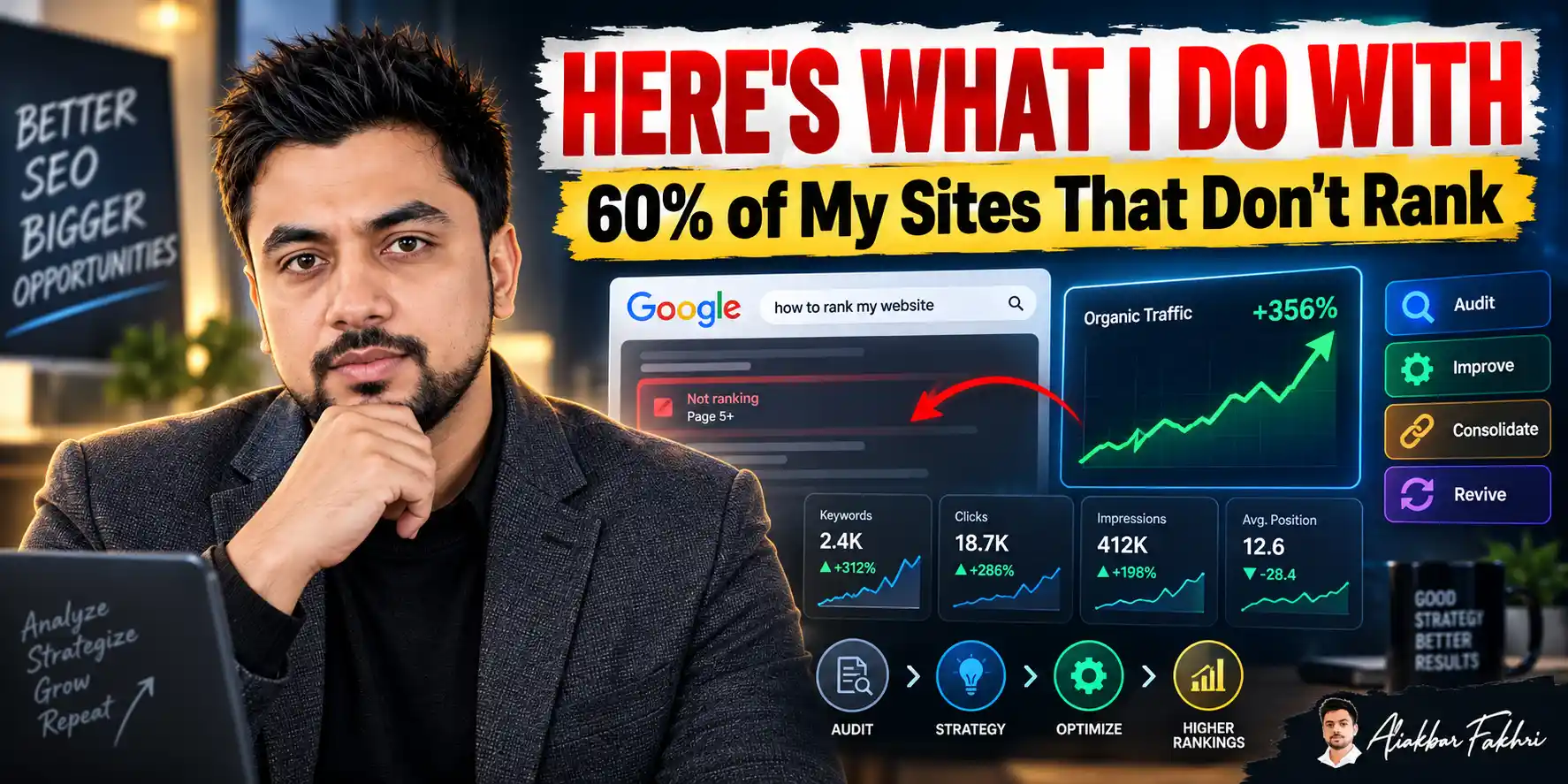
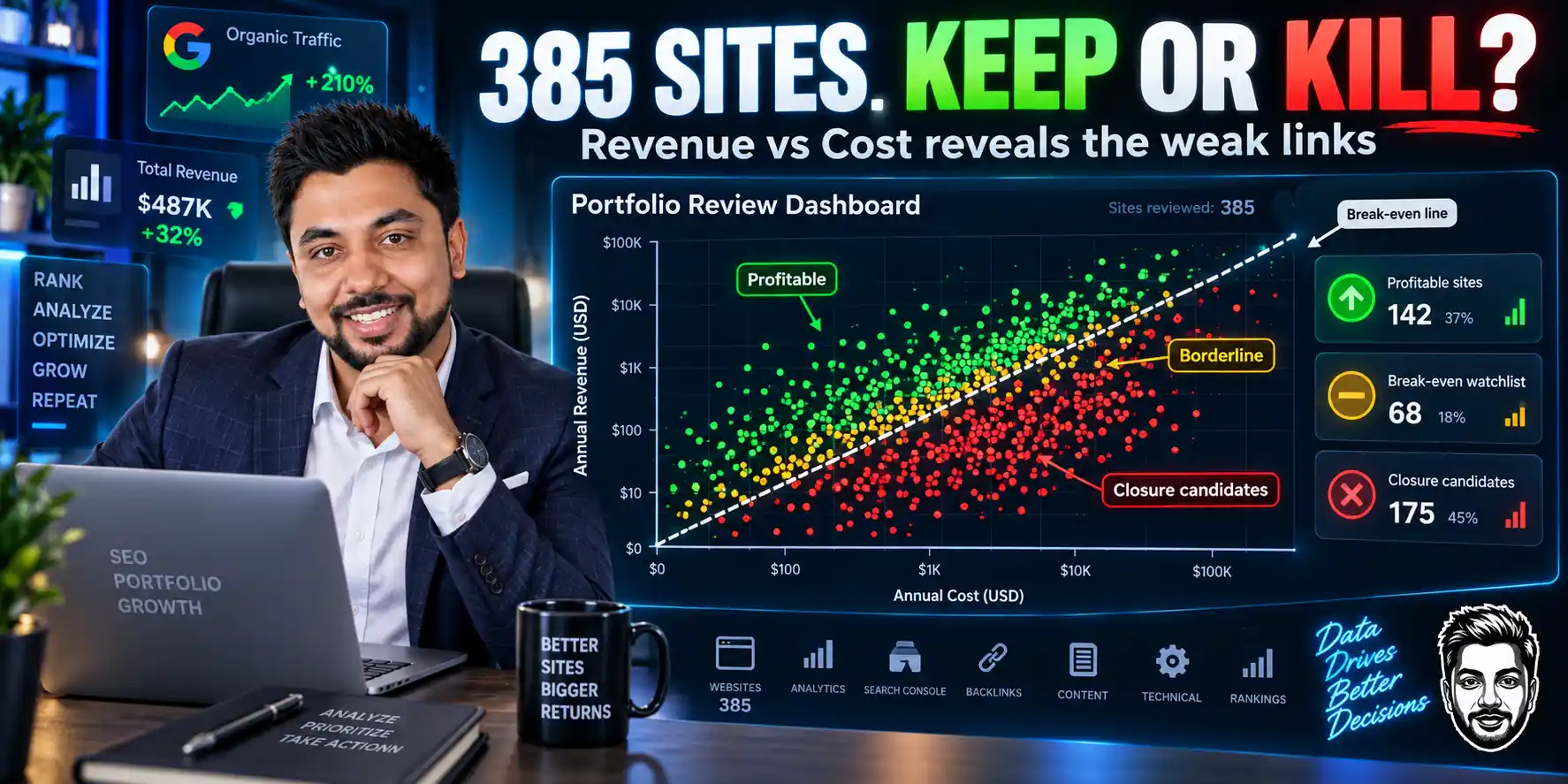
I run 385 websites. Roughly 60% of them do not rank where anybody would call it ranking.
They exist. They get indexed. They pick up a few hundred visits a month from long-tail terms nobody is fighting over.
They are not on page one for anything you would put in a pitch deck.
And I keep almost all of them.
Every few months somebody tells me to cut the dead weight. It is the most common advice I get and it is usually wrong, for a reason that has nothing to do with SEO and everything to do with arithmetic.

Here is the maths.
⚡ Quick Answer
A site earns its place if it makes more than it costs. That is the whole test.
A small site runs me about $50 a year all in — domain plus its share of a server. If it makes $100 a year, it is profitable.
Not impressive. Profitable.
The maths on one small site

Let us do one properly, because the abstraction is where people go wrong.
Take a small niche site. Forty articles, three years old, ranks for a few hundred long-tail terms and nothing competitive.

14-Day Semrush Free Trial
Find Long-Tail Keywords That Can Bring Dead Sites Back
Get a 14-day extended Semrush free trial and find low-competition long-tail keywords your stalled pages can realistically rank for. Use the data to identify missed opportunities, refresh weak content, and rebuild organic traffic around terms with clearer ranking potential.
What it costs me in a year:
| Line | Cost |
|---|---|
| Domain renewal | ~$11 |
| Share of server (many sites per box) | ~$25 |
| CDN and security | ~$4 |
| Monitoring, automated | ~$5 |
| Human attention | $0 most years |
| Total | ~$50 |
What it makes in a year: somewhere between nothing and a few hundred dollars, depending on whether one of its pages happens to sit on a decent affiliate term.
If it clears $100, it returns double what it costs. If it clears $60, it still returns more than it costs.
Now multiply. Two hundred small sites averaging even a modest margin is a real line in the accounts, and none of it requires anybody to show up on a Monday.
The part everyone gets wrong
That is the wrong comparison. The alternative to a site making $100 a year is not a site making $10,000 a year. The alternative is $0 and a domain you let expire.
The correct question is never “is this site good”. It is “does keeping it cost me more than letting it go”, and for a site with no human attached the answer is almost always no.
The only scarce resource in a portfolio is attention, not money. Once a site stops consuming attention, its economics change completely, and most advice about pruning was written before that was possible.
Why “kill it” is usually bad advice
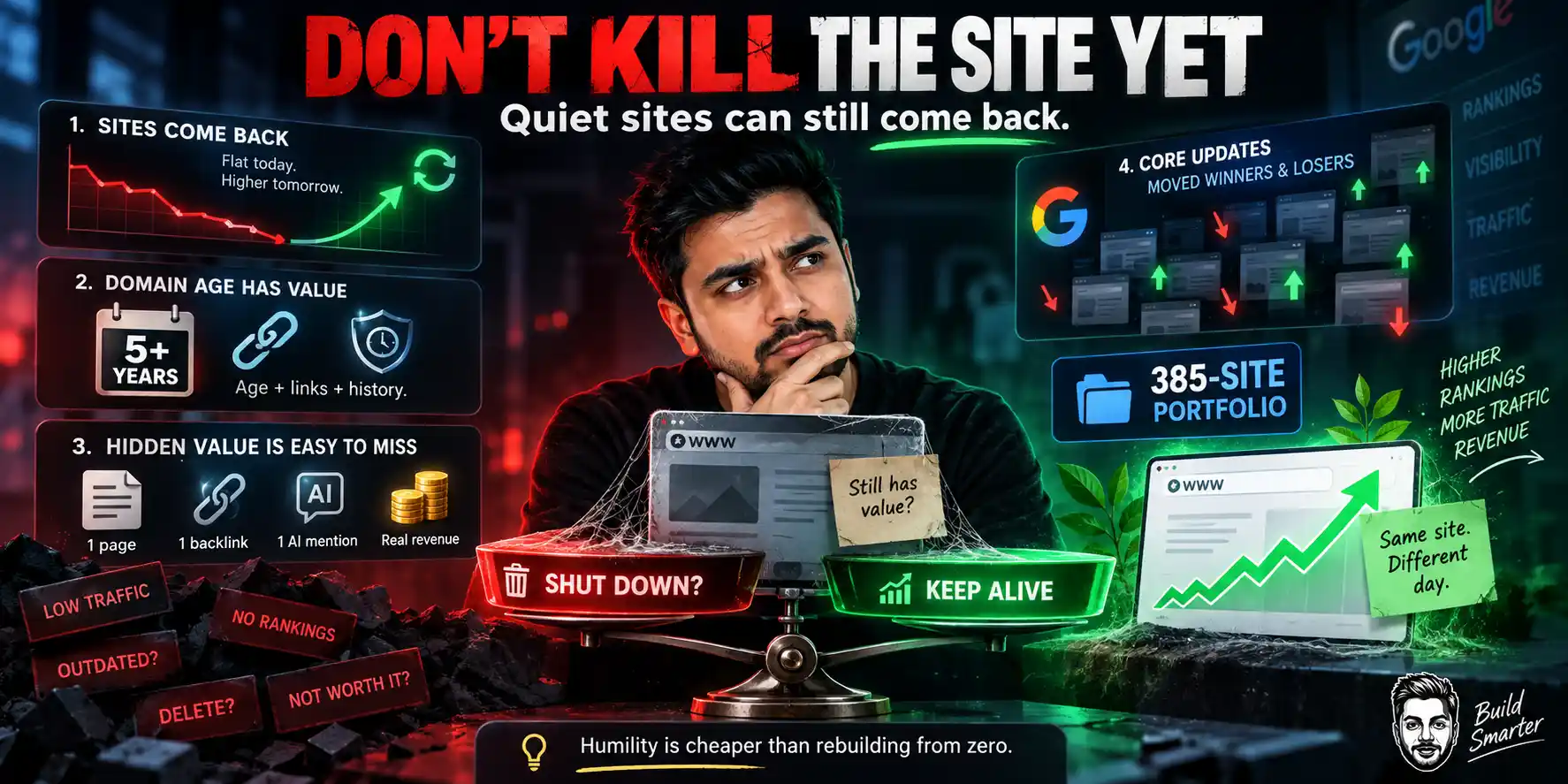
Three reasons, and I have learned all three the expensive way.
Sites come back
I have had sites sit flat for two years and then pick up traffic again. A competitor died, an algorithm moved, or a term I wrote about in 2022 became something people search for.
Four core updates in the last eighteen months. Every one of them moved things around. Some of our quietest sites gained from updates that hurt our best ones.
You cannot predict which. You can only still be holding the ticket.
The domain is worth more than the traffic
A five-year-old domain with real content, real links and a clean history is not replaceable. You cannot buy the age.
If I shut it down and want that position back in three years, I am starting from a domain with no history at all. The renewal fee is cheap insurance against a decision I cannot reverse.
You are wrong about which sites matter
This is the uncomfortable one.
Every year, at least one site I had mentally written off turns out to be carrying something. A single page ranking for a term with an unusually good commission. A backlink somebody built to it that quietly helps the whole network. A brand mention that shows up in an AI answer.
At 385 sites I do not have perfect visibility into which page is doing what. Neither do you, if you run more than thirty of anything.
Humility is cheaper than a domain renewal.
The four buckets
Every site in the portfolio sits in one of four states. This is reviewed quarterly and mostly by machine.
| Bucket | What it means | What we do |
|---|---|---|
| Growing | Traffic and revenue both rising | Invest. New content, new links, real attention |
| Steady | Flat, profitable, no attention needed | Leave it alone. Renew the domain |
| Declining but profitable | Falling, still clears its cost | Monitor. Do nothing unless it crosses the line |
| Underwater | Costs more than it makes, no path back | Close |
Most of the portfolio lives in “steady”. That is not a failure state. That is the goal state for a site that was never going to be a flagship.
The mistake I made for years was treating “steady” as a problem to be solved. I would pour work into a flat site trying to make it grow, and almost always that work would have returned more on a site already growing.
Attention should follow momentum. Money can sit still.
The 20/60/20 shape
Roughly, across our portfolio:
- About 20% are growing. These get nearly all the human effort.
- About 60% are steady or declining-but-profitable. These get automated monitoring and nothing else.
- About 20% are candidates for closing in any given year, and we close far fewer than that.
That top 20% pays for everything. The middle 60% pays for itself and occasionally surprises us. The bottom 20% is the only part where the “kill it” advice applies, and even there most get a stay of execution.
What automation actually changed
This is the genuinely new part, and it is why the arithmetic works now in a way it did not three years ago.
The old cost of a small site was not hosting. It was a person.
Somebody had to check whether it was up, whether the affiliate links still resolved, whether the SSL renewed.
Whether it had been hacked. Whether any page had stopped ranking. Whether anything at all needed doing.
Across 200 small sites, that is a full-time job nobody wants, doing work that is 95% confirming nothing happened.
What runs itself now
What it cost to build
Honestly? 9 weeks of work and 1 month to run.
It replaced a job that nobody was doing properly anyway, which is the real before-state. Before automation, small sites were not monitored carefully. They were monitored when something went visibly wrong, which is a different and worse thing.
The honest framing is not “automation saved us money”. It is that automation let us do something we were never actually doing, at a price low enough that it made 200 marginal sites viable.
The number that closes a site
Not traffic. Traffic is a terrible signal on a small site because it is noisy and because zero traffic can still mean a page with one good commission.
A site gets closed when it is underwater with no path back. Two conditions, and it has to be both.
Underwater means twelve trailing months where cost exceeded revenue. Not one bad quarter. A full year, because seasonality on a small site can be brutal and I have nearly closed sites in the trough of their own cycle.
No path back is the judgement call, and it is the one I keep for a human. It means: the niche is dead, the merchant programme closed, the content cannot be salvaged, or the domain picked up something in its history that is not worth fighting.
What does not get a site closed
In practice, over the last few years, the real reasons have been:
What actually gets sites closed
In practice, over the last few years, the real reasons have been:
Why I don’t flip sites
People assume a portfolio this size exists to be sold in pieces. It does not, and I want to explain the reasoning because I think the flipping model is worse than its reputation suggests.
A site sells for a multiple of its recent profit. Typically two to three years of it, sometimes less for something small and unbranded.
So a site making $100 a year sells for maybe $250. Against a $50 annual cost, keeping it pays that back in about five years and then keeps paying, indefinitely, with no effort.
And the sale is a one-time event with a permanent cost. You lose the domain age, the links, the brand mention, and the optionality. Everything I described in the “sites come back” section disappears the moment you transfer it.
There is also a time cost nobody prices in. Preparing a site for sale — cleaning the accounts, documenting the traffic, handling diligence, migrating it — takes real hours. Those hours are the scarce resource, and spending them on a $250 exit rather than on a growing property is a bad trade every time.

When flipping does make sense
I am not against it in principle.
- If the site is genuinely underwater and somebody will pay for the domain, take the money. That is not flipping, that is salvage, and it is strictly better than closing.
- If you need the cash. Liquidity has value and I am not going to lecture anybody about it.
- If you built it to sell. Different business, honestly practised, and some people are very good at it. It is just not what I do, and the arithmetic above is why.
My position: these are evergreen assets with a near-zero carrying cost. Selling an asset with a near-zero carrying cost for two years of earnings is a decision you have to have a specific reason for.
What a long tail is actually worth
This is the part people underestimate most.
A site that ranks nowhere for anything competitive can still rank first for things like “does [specific product] work with [specific other product]”. Nobody optimises for that. There is no volume in it.
But the intent on those terms is extraordinary. Somebody typing a question that specific is three minutes from a purchase decision, and there is often no competition at all.
Across a portfolio, hundreds of terms like that add up to something real. Individually they are invisible in any keyword tool. Collectively they are a meaningful share of what the small sites earn.
This is also why traffic is a bad closing signal. A site with 300 visits a month from 300 different long-tail questions can out-earn a site with 3,000 visits from one informational term.
I have both. The second one looks better in a screenshot. The first one pays better.
And now there is a second reason to keep them
AI assistants cite specific pages to answer specific questions.
A page that answers a narrow question well is exactly what gets pulled into an AI answer. That is a distribution channel which did not exist when most of these sites were built.
I am not going to overclaim this. I cannot give you a clean number for how much traffic or revenue it is worth to us yet, and anybody giving you one is guessing.
What I can say is that the shape of content that wins there is the shape my small sites already have. Narrow, specific, answering one thing properly. That is an argument for keeping them that did not exist three years ago.
What this costs me that I don’t like
I would not believe an article that said this was all upside.
Who should not run a portfolio
Questions people actually ask
When should you shut down a website?
When it has been underwater for twelve trailing months and there is no path back — the merchant programme closed, the niche died, or the content cannot honestly be salvaged. Both conditions, not one. Low traffic on its own is never a reason, and neither is losing a core update, because sites come back and closing during a drop means closing at the bottom.
Is it worth keeping a website that makes only $100 a year?
If it costs $50 a year to run and needs no human attention, yes. The comparison people make is against their best site, which is the wrong comparison. The real alternative is zero and an expired domain. The only thing that makes small sites unviable is labour, so the answer changes completely once monitoring is automated.
Should I sell my underperforming sites instead?
Only if they are genuinely underwater, or you need the cash, or you built them to sell. A site typically sells for two to three years of profit, and the sale permanently costs you the domain age, the links and the optionality. On a near-zero carrying cost, selling for two years of earnings needs a specific reason.

Aliakbar Fakhri
The founder of AFFINCO
Stop asking whether the site is good. Start asking whether it costs you anything.
Most of mine are not good. Almost all of them are free to keep.
Evidence beats hype. Every time.
Affiliate Disclosure: This post may contain some affiliate links, which means we may receive a commission if you purchase something that we recommend at no additional cost for you (none whatsoever!)
Similar Posts







About the author:
Aliakbar Fakhri
Founder & CEO of AFFiNCO
I’m Ali, Founder of AFFiNCO, with 15+ years in SEO, paid ads and affiliate marketing.
I run 65+ sites of my own, so every strategy on this blog was tested on my money before it reached you. No guru fluff. Just what actually works.