
AFFiNCO Agency Stack 2026: Every Layer, Tool and Real Cost

By :
Ali
September 17, 2026
Everybody publishes a tool stack. Almost nobody publishes the bill.
So here is ours. AFFiNCO runs 385 websites, 46 people across six countries and more than 60 enterprise clients.
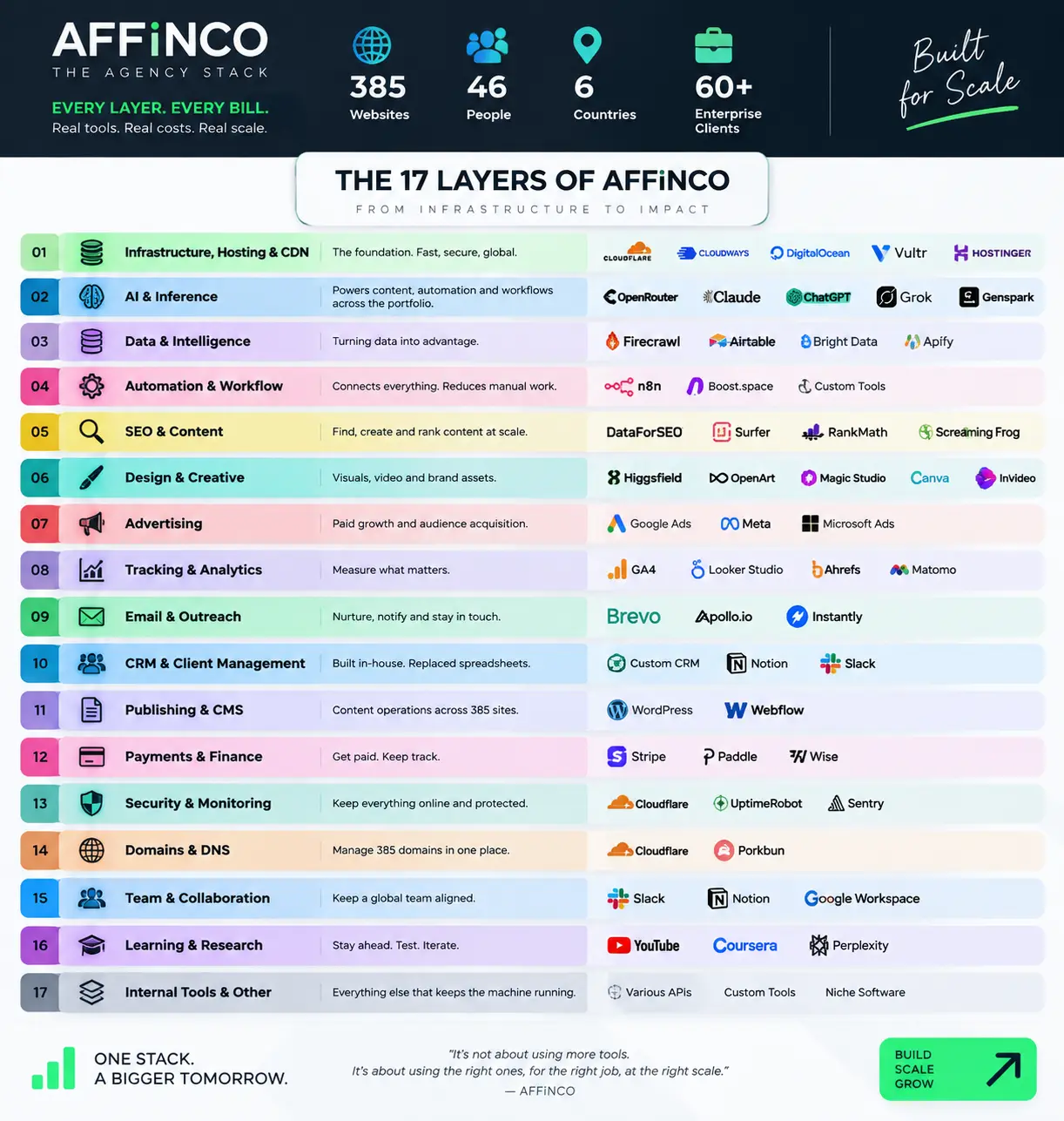
This is every layer that keeps it up, what sits in each one, and where the money actually goes. More about the operation sits on the about page.
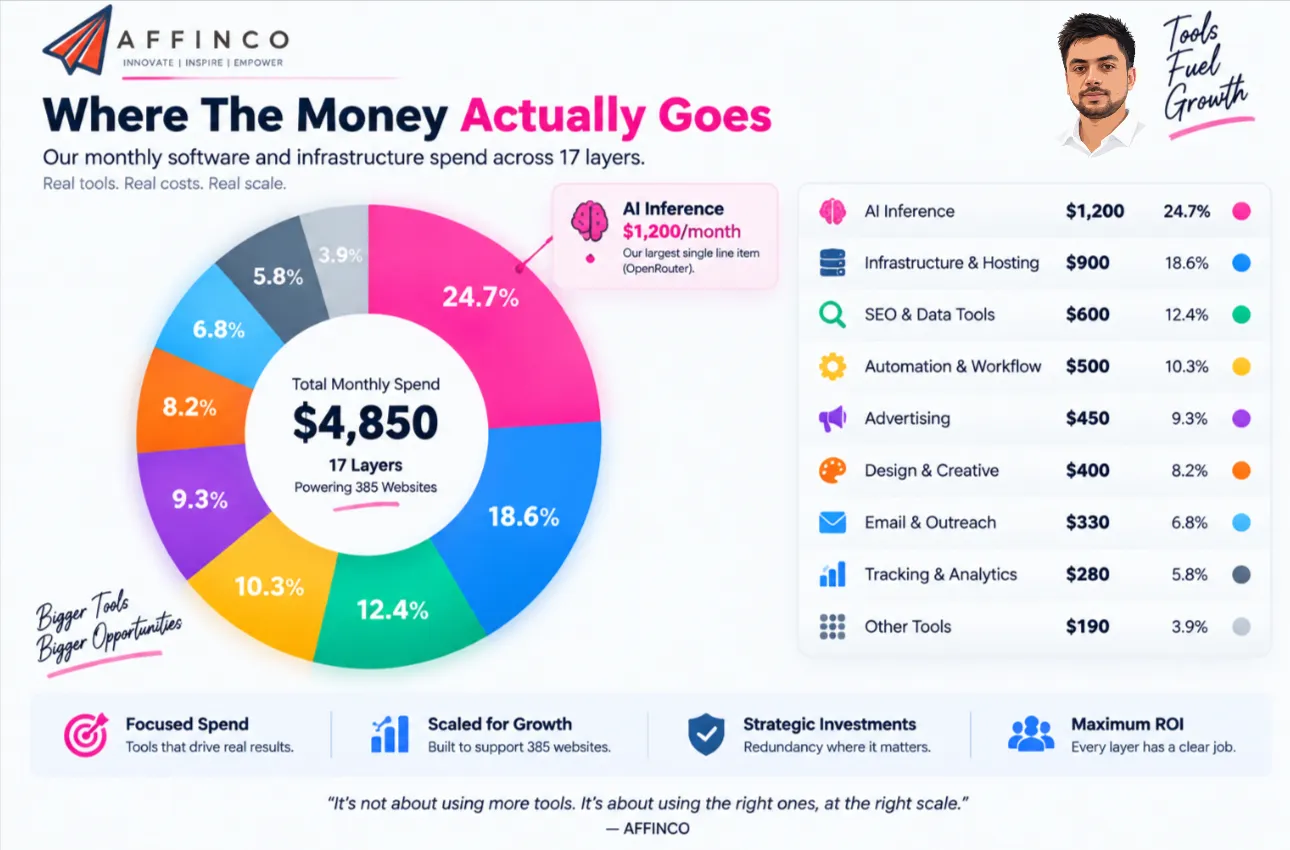
The thing that surprises people is which line is biggest. It is not hosting. It is not the SEO tools everybody argues about. I will get to it in the second section and it is not close.
✅ Bottom Line Up Front
How to read this
Three things before the tables.
Infrastructure, hosting and CDN
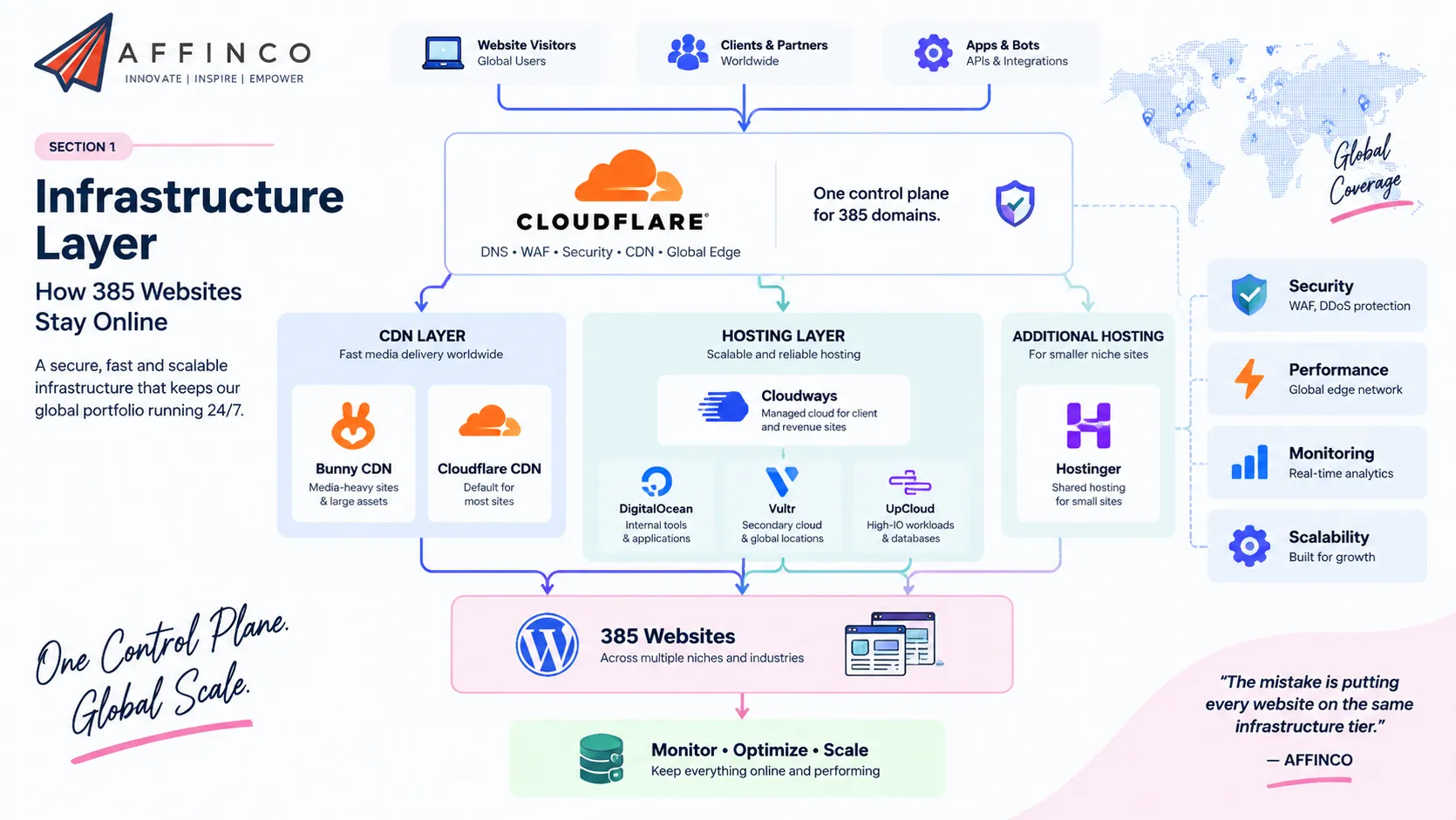
The layer everybody underestimates until it is 3am.
| Tool | What it does for us | Why it stays |
|---|---|---|
| Cloudflare | DNS, WAF, caching, security across the whole estate | Single control plane for 385 domains. Nothing else comes close |
| Cloudflare CDN | Edge delivery, default for most sites | Included, fast, one less vendor |
| Bunny CDN | CDN for media-heavy properties | Cheap per GB and genuinely fast. Where Cloudflare is not the right shape |
| Cloudways | Managed cloud for client and revenue sites | Managed layer without managed-host pricing. Pays a lifetime revshare too |
| DigitalOcean | Raw droplets for internal tools and app workloads | Predictable pricing, good API, easy to script against |
| Vultr | Secondary cloud, geographic spread | Locations DigitalOcean does not have |
| UpCloud | High-IO workloads | Genuinely faster storage. We notice it on database-heavy jobs |
| Hostinger | Shared hosting for small niche sites | The economics of 200 small sites only work at this price point |
The thing worth copying here is the split. Small sites live on cheap shared hosting because their revenue does not justify anything else. Revenue sites and client sites live on managed cloud. Internal tools live on raw droplets.
Putting everything on one tier is the most common infrastructure mistake I see. You either overpay for the long tail or underserve the properties that matter.
Cloudflare in front of everything is not optional at this size. One place to change DNS, one place to block a bad actor, one place to see what is happening. The alternative is 385 separate conversations.
AI and inference — the biggest line
This is the section that changed our cost structure more than anything else in a decade.
| Tool | What it does for us | Notes |
|---|---|---|
| OpenRouter | Model routing for AI running inside WordPress across the portfolio | ~$1,200/month. Our single largest software line |
| Claude (Max) | Strategy, long-context analysis, anything client-facing, most of our internal tooling | The one I use personally, all day |
| ChatGPT (Max) | Second opinion, different failure modes, specific workflows | Different model, different blind spots |
| Grok | Fast queries, real-time-flavoured work | Cheap per task |
| Grok Bot | Agent-style automation on a cloud machine | Useful. See the security caveat below |
| Genspark (Max) | Research passes and deck building in one place | Go and find the material, then build from it |
| Abacus AI | Team access to multiple models under one seat | Cost-effective way to give a team model access |
Why OpenRouter is the biggest line
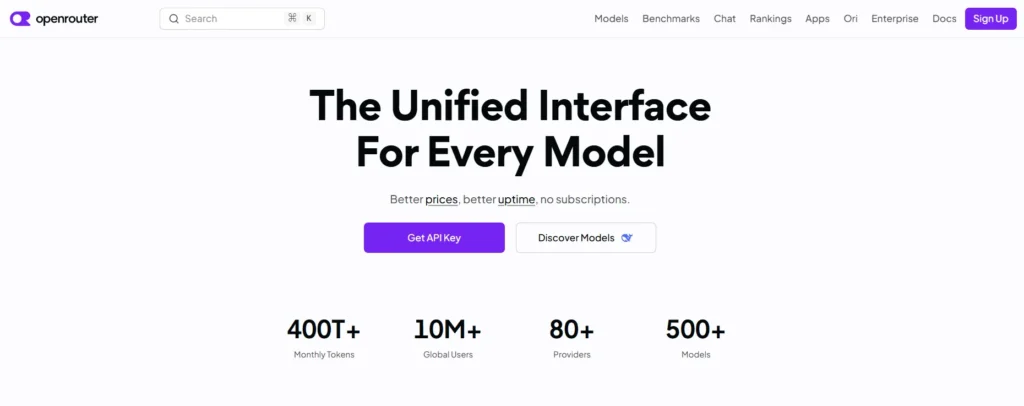
Because we run AI inside the product, not just alongside it.
A large part of the portfolio has AI features built into WordPress. Content assistance, internal linking suggestions, on-page work, summarisation. Every one of those calls a model, and at 385 sites the calls add up fast.
OpenRouter sits in front of all of it. One API, one bill, and the ability to change the model behind a workflow without touching the workflow. When a cheaper model gets good enough for a given job, we move it and the saving is immediate.
That routing ability is the actual product. If we had wired every site directly to one provider, we would be locked to that provider’s pricing and that provider’s outages.
The honest number: roughly $1,200 a month, and it moves with usage. It is more than our hosting. It is more than our SEO tools. Nobody predicted that three years ago, least of all me.
One caveat on agent tools
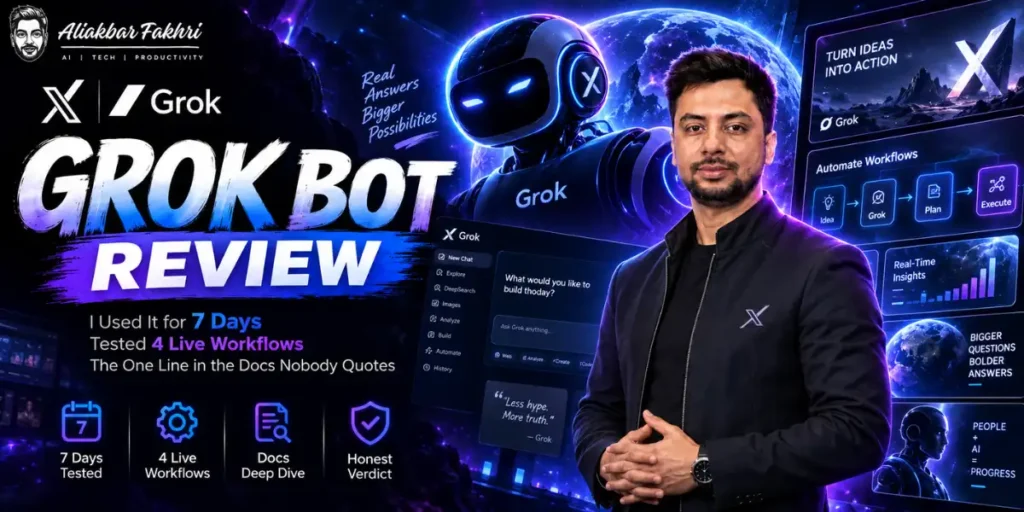
Grok Bot gives each account a single shared cloud machine. Every bot and every plugin runs on it, and xAI’s own documentation says plainly not to treat separate bots as a security boundary.
So we use it, and we do not put payment credentials on it. That is the whole policy and it is not negotiable.
Data, scraping and enrichment
| Tool | What it does for us | Notes |
|---|---|---|
| Firecrawl | Crawls and structures any site we take on | The tool I would fight hardest to keep |
| Apify | Actors for specific recurring extraction jobs | Where Firecrawl is the wrong shape |
| DataForSEO | Bulk SERP, keyword and backlink data via API | At our volume, manual tools are not physically possible |
| Custom API scheduling | Internal jobs that pull, transform and store on a schedule | Built in-house, runs on our own droplets |
Why Firecrawl is the lifeline
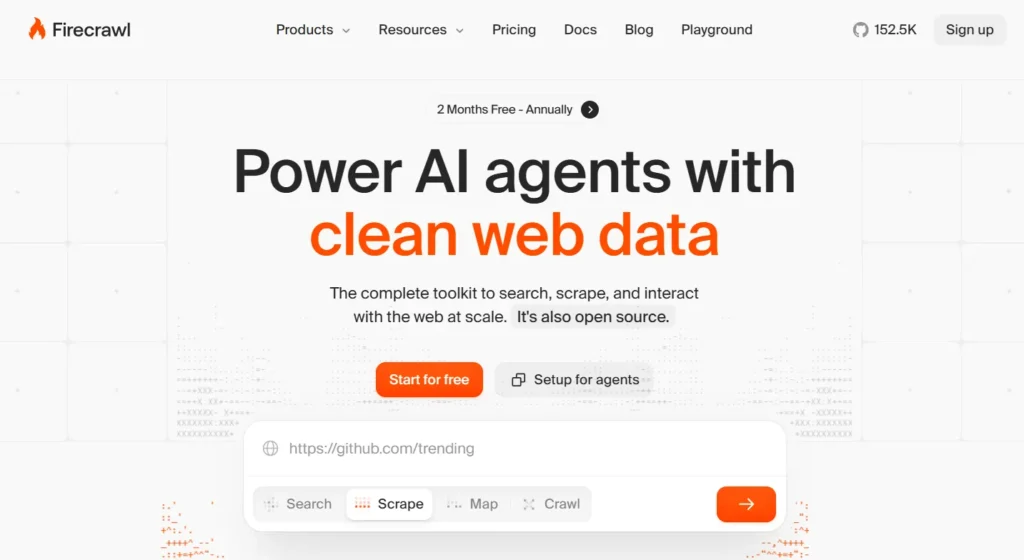
It is the first thing we point at every new website.
Client onboarding, competitor analysis, a portfolio site nobody has opened in a year. The first move is always the same — crawl it properly and get structured output we can reason over.
Before this, that job was a person with a spreadsheet and a weekend. Now it is a job that runs while we do something else, and the output is clean enough to feed straight into an analysis.
Copy AFFiNCO’s Web Scraping Workflow with Firecrawl
Firecrawl is the tool we use to crawl websites, extract structured information, and turn messy pages into AI-ready data. Try the same scraping workflow behind our research and automation systems.
1,000 Free Credits/Mo

Turn any website into clean, structured data in minutes. Start free and get 1,000 credits every month.
If it disappeared tomorrow, several workflows stop that day. There are alternatives. None of them are drop-in, and the switching cost is measured in weeks.
That is a dependency and I am aware of it. Some dependencies are worth accepting.
On DataForSEO
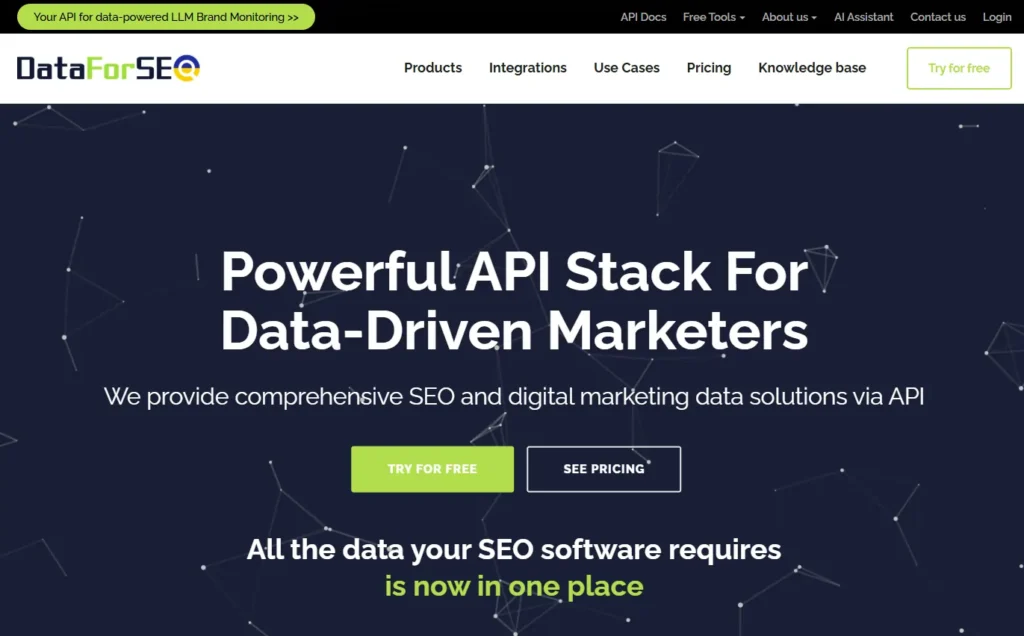
This one changed how we handle an algorithm update.
When a core update lands, the first question is always the same: what actually moved, across how many properties, in which direction. With a UI tool you answer that for ten sites. With an API you answer it for 385.
Pulling that data through Claude is what made it usable. The API gives you a firehose. Something has to turn it into a sentence a human can act on, and that is the part that used to take a week.
Automation and orchestration
| Tool | What it does for us | Notes |
|---|---|---|
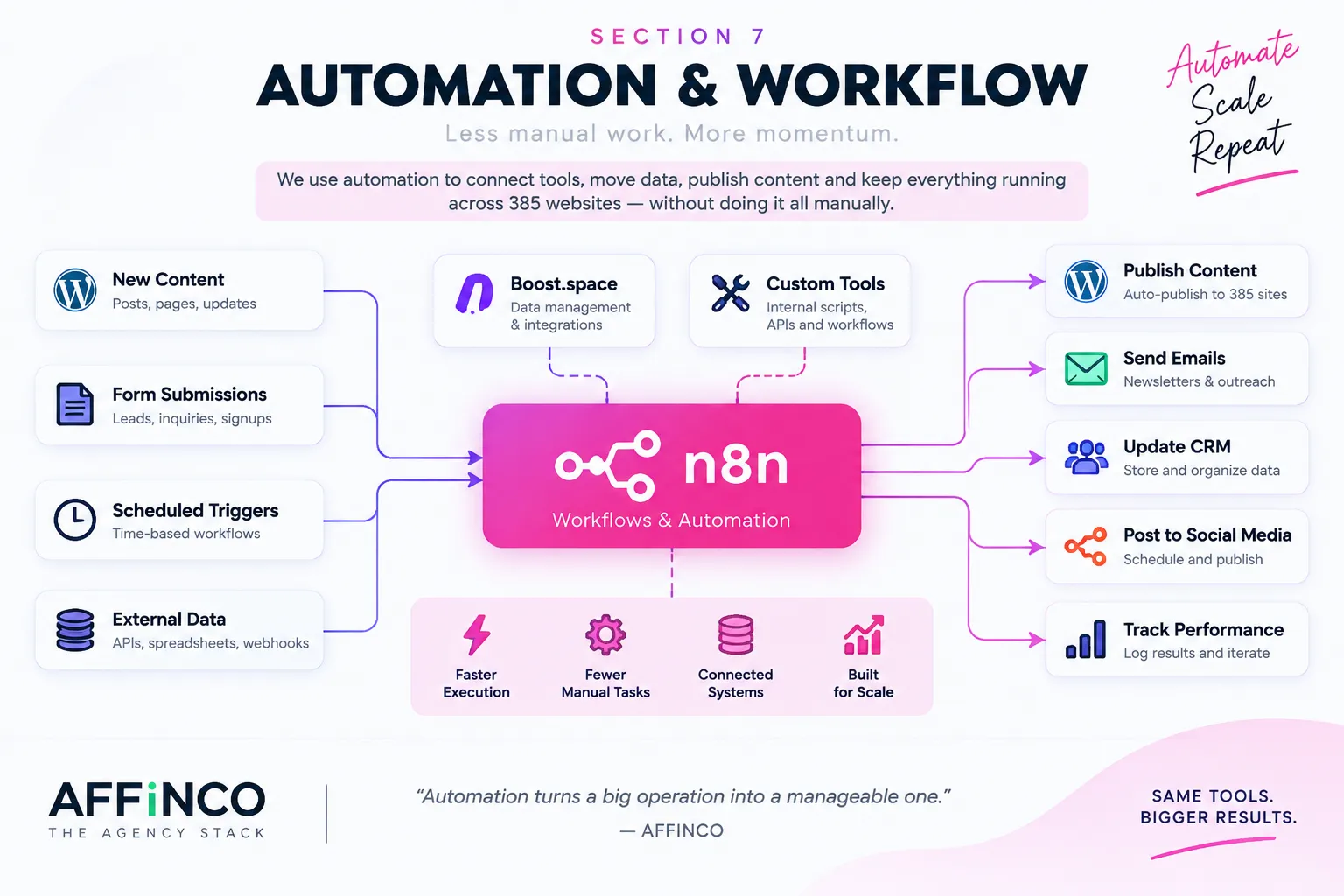
| n8n | Long-running workflows, most of them years old | Self-hosted for anything touching client data |
| Boost.space | Data sync and centralisation between systems | Where n8n is not the right tool |
| Custom scheduling | Internal cron jobs and API pulls | Cheaper and more predictable than paying per execution |
We still run n8n and I want to be straight about why. Not because it is the newest option. Because our old workflows work, they have been debugged over years, and rewriting working automation is a hobby, not a business decision.
It bills on full workflow executions rather than per step, which suits agent-shaped work where one job fires forty tool calls. The community edition is free to self-host, and that is what we use for anything touching a client.
The rule across this layer: if it touches client data, it runs on infrastructure we control. No exceptions, and that rule has cost us convenience more than once.
SEO and content
| Tool | What it does for us | Notes |
|---|---|---|
| Semrush | Position tracking, backlink audit, competitive research | The backlink audit earns its place on its own |
| Surfer SEO | Content gap analysis against what is already winning | We use it to find the gap, not to hit a density target |
| DataForSEO | Bulk everything, via API | Covered above |
| Rank Math | On-page SEO across the WordPress estate | Runs on the majority of our sites |
The honest note on this layer: it is smaller than people expect for an SEO agency.
We had more tools. We cut them, because most SEO software overlaps heavily and paying three vendors for the same rank data is a habit, not a strategy.
What survived did so because it does one thing nothing else does. Semrush’s backlink audit. Surfer’s gap analysis. DataForSEO’s volume. Rank Math’s presence on every install.
Social media and publishing
| Tool | What it does for us | Notes |
|---|---|---|
| ContentStudio | Scheduling and publishing across client and owned accounts | The workhorse |
| Zernio | Publishing through official APIs, handles posting quotas | Quota handling matters more than it sounds |
| Various small tools | Niche jobs, specific platforms | Dozens of them, none load-bearing |
The quota point deserves a sentence. Instagram caps API publishing at 100 posts per rolling 24 hours, carousels counting as one. At our volume that ceiling is real, and a scheduler that silently truncates a batch at 100 is a problem you find out about later.
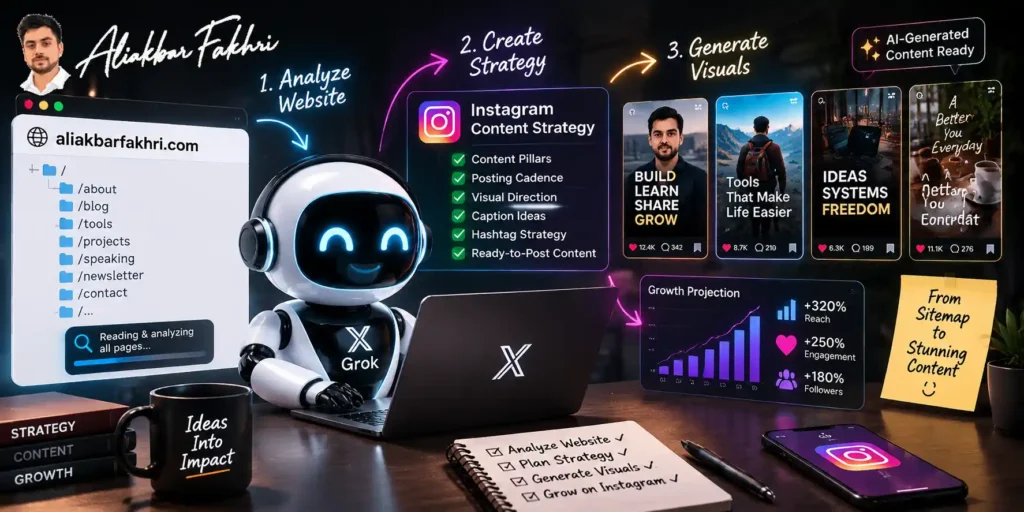
And the long tail of small tools is a genuine mess. We have dozens. Most were bought for one campaign and never cancelled. I will come back to that in the weaknesses section because it is the least defensible part of this stack.
Design and creative
| Tool | What it does for us | Notes |
|---|---|---|
| Higgsfield | Character-consistent stills and short video | Paid subscription. Genuinely good for avatars |
| OpenArt | Image generation and character work | Check the licence tier before you generate at volume |
| Magic Studio | Editing, cleanup, headshots | Formerly InstaHeadshots |
| Canva | Everything visual, for six years | Still there. Used far less than it was |
| InVideo | Video when a specific job calls for it | Occasional rather than daily |
Canva is the interesting entry here. Six years as the default tool for anything visual, and it is now one of the least-used things in this stack.
Not because it got worse. Generative tools took over the part we used it for most.
Canva is now where we go when somebody needs to edit a thing rather than make one.
Paid media
| Platform | What we run | Notes |
|---|---|---|
| TikTok for Business | Client and owned campaigns | Official partner |
| Meta Business / Meta Ads | The volume platform | Still where most of the spend sits |
| Google Ads | Search and performance campaigns | Obvious, unavoidable |
| Reddit Ads | Niche targeting, specific verticals | Underrated, cheap in the right niche |
| ChatGPT Ads | New surface, still learning it | Too early for me to have a strong opinion |
| Point2Web | Google Ads agency we work with | We do not do everything in-house, and this is one of them |
On Point2Web specifically: we run a full-service agency and we still use another agency for some Google Ads work. That is not a contradiction.
Specialism beats breadth on paid search, and pretending otherwise costs clients money. If somebody is better at a thing than my team, using them is the correct answer.

On ChatGPT Ads: it is new, we are testing it, and I do not yet have enough data to tell you whether it works. When I do, I will write it up with the numbers.

Antidetect and proxies
| Tool | What it does for us | Notes |
|---|---|---|
| Dolphin Anty | Profile management for multi-account work | Primary |
| GoLogin | Secondary profile manager | Different team, different preference |
| AdsPower | Third option, automation-friendly | Good API |
| NodeMaven | Residential proxies | Pays crypto only — worth knowing before you sign up |
| IPRoyal | Proxies, our main volume provider | We hold a dedicated coupon with them |
Three antidetect browsers is more than anybody needs. I know. Different teams standardised on different tools at different times and consolidating them has never been urgent enough to actually do.
That is an honest answer rather than a good one.
Affiliate tracking
| Tool | What it does for us | Notes |
|---|---|---|
| RedTrack | All affiliate and campaign tracking | The fastest we have used |
One tool, no redundancy, and that is deliberate.
Tracking is the layer where switching is most painful. Every campaign URL you have ever published points at your tracking domain. Moving it means either breaking history or running two systems in parallel for months.
So we picked one, we picked carefully, and we stay.
RedTrack’s Builder tier gives two million events at $69 a month. For comparison, the best-known competitor charges $119 for one million. That gap is why we are here.
📊 Track Every Click Like AFFiNCO Does With RedTrack
RedTrack helps marketers track campaigns, analyze conversions, and understand where revenue actually comes from. It is the tracking layer behind performance-focused workflows.
Get 20% OFF RedTrack and build a smarter affiliate tracking system from day one.
Exclusive Codes
20% OFF for 3 Months
20% OFF for first month
The thing to understand about tracker pricing is that an event is not a click. Most cloud trackers count impressions as billable events too, so a million events is not a million visits. Model your own funnel shape before you compare plan prices, because the plans are not comparable.
Newsletter and email
| Tool | What it does for us | Notes |
|---|---|---|
| beehiiv | The AFFMaven newsletter, 69,572 subscribers | Where the audience lives |
| Emailit | Transactional sending | One of the best tools we run. Quietly excellent |
| MailerLite | Campaign sending on specific properties | Situational now rather than core |
Emailit is the one nobody has heard of and it deserves the mention. Transactional email is invisible when it works and catastrophic when it does not. Ours works.
beehiiv holds the thing that matters most in this whole stack. 69,572 people who chose to hear from us, across 104 countries. Traffic is rented. That list is owned.
If I had to keep one asset from this entire article and delete the rest, it would be that list. It is not close.
CRM and internal ops
| Tool | Status | Notes |
|---|---|---|
| Our own CRM | Current | Built in-house, fits how we actually work |
| Google Workspace | Current | Mail, docs, the boring backbone |
| Airtable | Dropped | Was the backbone for years |
| Google Sheets | Dropped for ops | Still fine for a quick calculation. Not for running a business |
We built our own CRM and I would not recommend it to most people.
The reason it made sense for us is that our workflow is unusual. A media network and an agency share the same contact graph, with affiliate partners, sponsors, clients and publishers all in one place.
No off-the-shelf CRM models that well, and we tried several.
What killed the spreadsheets was not the spreadsheets. It was that we could finally build something better without hiring a development team for a year. That is a genuine change in what a small operation can do, and it happened in the last eighteen months.
Google Sheets in particular was a crutch. It was where anything without a home went, and things without a home multiply. I do not miss it.
Booking and scheduling
| Tool | What it does for us |
|---|---|
| Cal.com | Client and partner calls |
| TidyCal | Secondary booking, bought through AppSumo |
Small layer, nothing clever. TidyCal came from an AppSumo deal years ago and still works, which is the best thing you can say about a lifetime deal.
Analytics
| Tool | What it does for us | Notes |
|---|---|---|
| Cloudflare Analytics | Server-side traffic across the estate | No client-side tag, no consent problem, no ad-block gap |
| Google Analytics | Where clients expect the numbers to be | Reporting, mostly |
| Heatmaps | Specific pages during CRO work | Situational, not always-on |
Cloudflare Analytics being first is deliberate. It sits at the edge, so it sees requests that never reach a JavaScript tag. On a portfolio where a meaningful share of visitors block trackers, the edge number and the tag number disagree, and the edge number is closer to the truth.
We still run Google Analytics because clients want to see it and because the integrations matter. But when the two disagree, I trust the edge.
Landing pages
| Tool | Status |
|---|---|
| Swipe Pages | Still in the stack, used far less |
| Everything else | Dropped |
This is the layer I would now argue you may not need at all.
We used more page builders than I want to list. Today, most of our landing pages come out of AI-assisted builds — described, generated, refined, shipped — and the result is faster and better-fitting than a template.
The builder became the slow step. When the constraint was design ability, a builder solved a real problem. When the constraint is speed, dragging blocks around is friction.
Swipe Pages stays for specific jobs. I am not sure it survives another year, and that is not a criticism of the product.
Invoicing and accounting
| Tool | What it does for us |
|---|---|
| Zoho Books | Invoicing, primary |
| QuickBooks | Accounting, where the accountants want it |
Two tools because the people who send invoices and the people who file accounts want different things. Consolidating would make one of those groups unhappy and save almost nothing.
Payments and payouts
| Tool | What it does for us | Notes |
|---|---|---|
| Wise | Multi-currency, international | Our favourite. Best rates, least friction |
| Payoneer | Where networks pay by default | Many affiliate networks only pay here |
| PayPal | Legacy and small payments | Still unavoidable |
| Skydo | Receiving international payments into India | Built for exactly this problem |
| Stripe Atlas | Company structure | Infrastructure, not a payment rail |
Wise is the one I would tell anybody to start with. Running a business across six countries means currency conversion is a real cost line, not a rounding error, and the difference between a good provider and a bank is measured in percentage points.
The reason there are five entries here is that you do not get to choose how people pay you. Affiliate networks pay where they pay. Clients pay how their finance department allows. You hold accounts because the other side holds accounts.
Skydo is worth naming for anyone operating from India. Receiving international payments into an Indian account has specific friction, and a tool built for that specific problem beats a general one.
Virtual cards
| Tool | What it does for us |
|---|---|
| RedotPay | Cards funded from crypto, issued on demand |
| E.PN | Virtual cards for ad accounts |
| PST.net | Virtual cards, media buying |
| KAST | Business account with low fees and one-click crypto conversion |
Why an agency needs four virtual card providers is a question with a boring answer: ad platforms decline cards, and they decline them unpredictably.
Running paid media at any scale means having more than one way to fund an account. This is not sophistication, it is redundancy against a problem nobody has solved.
The crypto-funded cards are about speed, not ideology. Moving money into an ad account in minutes rather than days is worth a fee when a campaign is live.
Domains
| Registrar | Use | Why |
|---|---|---|
| Porkbun | First choice for new domains | Best pricing, clean interface, no upsell theatre |
| Namecheap | Second choice, bulk | Good at volume, reliable |
| GoDaddy | Legacy holdings | Where old domains live |
Recommended in that order, and the order matters. Porkbun for anything new. Namecheap when buying in bulk. GoDaddy because some domains have been there for a decade and moving them is a job nobody wants.
Renewal pricing is where registrars get you. The first year is a promotion. Check year two before you buy 40 domains, because at portfolio scale that difference is a real number.
What we dropped and why
More useful than the list of what we kept.
| Dropped | Why | What replaced it |
|---|---|---|
| Airtable | Outgrew it. Wanted our own data model | Our own CRM |
| Google Sheets for ops | Became the place things went to be forgotten | Our own CRM |
| Most landing page builders | The builder became the slow step | AI-assisted builds |
| Several SEO tools | Three vendors, one rank number | Semrush and DataForSEO |
| Canva as the default | Generative tools took the job it did most | Higgsfield, OpenArt, Magic Studio |
| A long list of small social tools | Bought for a campaign, never cancelled | Still cancelling, honestly |
The pattern across every one of those is the same. We did not drop a tool because it got worse. We dropped it because the job it did stopped being a job, or because something upstream made it unnecessary.
Airtable is the clearest case. It was genuinely good and it was genuinely the right answer for years. What changed was that building the exact thing we wanted stopped requiring a development team, and at that point a flexible database became a compromise rather than a solution.
The small social tools are the least defensible line in this article. Dozens of subscriptions, bought for specific campaigns, each one too small to notice on a statement. Collectively not small at all.
If you take one operational lesson from this whole piece, make it that one. The subscriptions that hurt are never the big ones. You review the big ones. Nobody reviews an $11 tool.
What I would add next
Things not in this stack that I think should be, roughly in the order I would add them.
Where this stack is weak
Who should not copy this
Questions people actually ask
What is the biggest cost in an agency tool stack?
For us it is AI inference, at roughly $1,200 a month through OpenRouter alone — more than hosting and more than all our SEO tools combined. That is because we run AI inside WordPress across a large portfolio rather than just using chat tools. If your AI usage is conversational rather than embedded in a product, your biggest line will still be hosting or your main SEO subscription.
Should an agency build its own CRM?
Usually not. It made sense for us because a media network and an agency share one contact graph, with clients, sponsors, affiliate partners and publishers in the same system, and no off-the-shelf product modelled that well. The thing that changed is that building it no longer needs a development team for a year. Weigh that against the fact that nobody ships you updates or fixes bugs you have not noticed.
Do I still need a landing page builder in 2026?
Increasingly, no. We kept one and use it far less than we did, because AI-assisted builds now produce a better-fitting page faster than dragging blocks around a template. The builder solved a design-ability problem. If your constraint is speed rather than design ability, the builder is now the slow step.

Aliakbar Fakhri
The founder of AFFINCO
Stop collecting tools. Start naming the job each one does.
Every layer here exists because something broke under repetition. Nothing here was bought in anticipation.
Evidence beats hype. Every time.
Affiliate Disclosure: This post may contain some affiliate links, which means we may receive a commission if you purchase something that we recommend at no additional cost for you (none whatsoever!)
Similar Posts



About the author:
Aliakbar Fakhri
Founder & CEO of AFFiNCO
I’m Ali, Founder of AFFiNCO, with 15+ years in SEO, paid ads and affiliate marketing.
I run 65+ sites of my own, so every strategy on this blog was tested on my money before it reached you. No guru fluff. Just what actually works.