
Best SERP APIs 2026: 10 Google Search APIs Compared by Cost

By
Ali
November 11, 2026

Every SERP API prices itself differently on purpose.
Credits, requests, results, plans, “starting from” rates that only apply at volume you’ll never hit. It’s not an accident. It makes comparison hard, and hard comparison protects margin.
So I did the boring thing. I converted all ten to one number: dollars per 1,000 Google SERP results.
Same maths, same engine, entry tier where a vendor has one.
The spread is 42x between the cheapest and the most expensive. Two vendors couldn’t be converted at all because they don’t publish enough to compute it, and I’ve said so rather than guessing.
⚡ The Whole Article in One Table
| Provider | Cost per 1,000 Google SERPs | Free tier | Notes |
|---|---|---|---|
| DataForSEO | $0.60 standard queue | $1 credit, never expires | $50 minimum payment |
| Serper.dev | ~$1.00 entry (~$0.30 at top volume) | 2,500 queries | Pricing page 404s |
| Oxylabs | $1.00 → $0.80 by tier | 2,000 results | JS rendering costs extra |
| ValueSERP | $2.00 → $1.00 by tier | Unstated size | Google only |
| Bright Data | $1.50 PAYG → $1.31 at scale | 5,000 req/mo | Unlimited concurrency |
| ScraperAPI | $12.25 → $2.30 by tier | 1,000–5,000 (they disagree) | Google costs 25 credits |
| SearchAPI.io | $4.00 → $1.00 by tier | 100 requests | Has ChatGPT/Gemini endpoints |
| SerpApi | $25.00 → $9.17 at scale | 250 searches/mo | Legal shield included |
| ZenRows | Not computable | 5,000 credits | No dedicated SERP product |
| ScrapingBee | Not computable | 1,000 credits | Credit cost unpublished |
That’s the 42x. Now let me explain why SerpApi still has customers, because the number alone would be unfair.
Why I Care About This Number
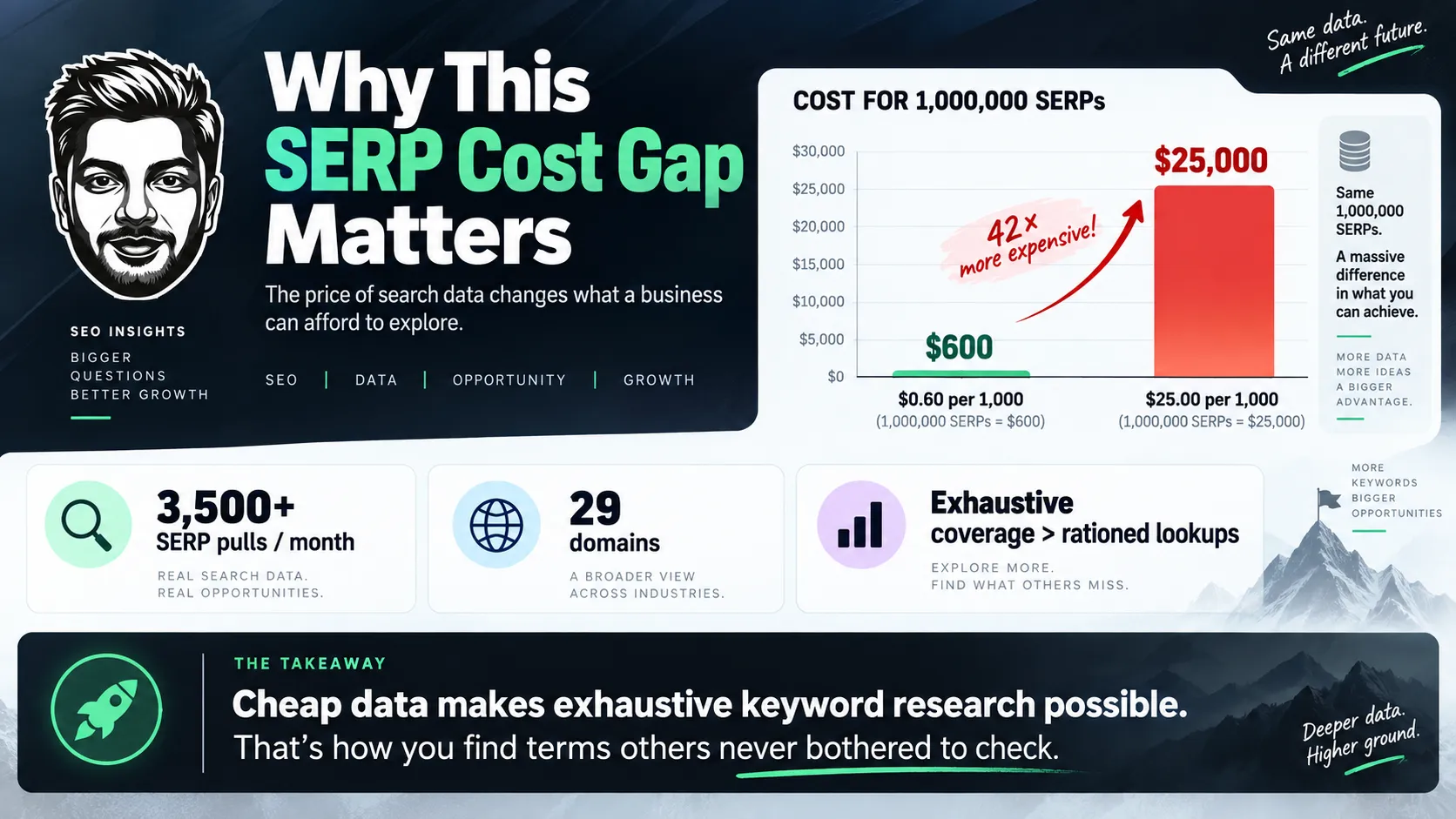
I run 3500+ SERP pulls a month across AFFiNCO’s client work and my own 29 domains.
At $0.60 per thousand, a million SERPs costs $600. At $25.00 per thousand, the same million costs $25,000.
That’s not a procurement decision. That’s the difference between a business model that works and one that doesn’t.
When I built the keyword research layer for our agency stack, this single line item decided the architecture. We could afford exhaustive coverage instead of rationed lookups, and exhaustive coverage is what lets you find the terms nobody else bothered to check.
Cheap data changes what you’re willing to look for. That’s the actual point.
The Cheap End
1. DataForSEO — $0.60 per 1,000, and it isn’t close
This is the foundation layer of my entire research stack and has been for two years.
Three speeds, three prices, and you pick per call — so background jobs run cheap and interactive lookups run fast. Each additional SERP page costs 75% of base. Coverage is genuinely broad: Google Organic, AI Mode, Maps, Local, News, Events, Images, Jobs, Autocomplete and Ads, plus Bing, YouTube, Yahoo, Baidu, Naver and Seznam.
That AI Mode endpoint deserves a callout. DataForSEO is the only provider here with a dedicated Google AI Mode SERP endpoint. If you’re building anything GEO-related, that’s not a nice-to-have.
They also ship an official MCP server at mcp.dataforseo.com/mcp, or run it locally via npx dataforseo-mcp-server. It authenticates with your normal API credentials and costs nothing beyond credit consumption. Claude queries live keyword data in conversation, no integration written.
Two honest catches. There’s a $50 minimum payment despite the pay-as-you-go framing. And they publish no fixed rate limit — you discover it from X-RateLimit-Limit headers at runtime, which is fine for engineers and irritating for everyone else.
The free trial is $1 of credit with no expiry, which is about 833 high-priority SERPs. Nobody else offers open-ended free credit.
If you’re pulling volume, this is the answer. I’d need a very specific reason to use anything else.
2. Serper.dev — cheap, fast, and hiding its own prices
Serper is genuinely fast and genuinely cheap, and it makes it strangely hard to find that out.
serper.dev/pricing returns a 404. Packs sit behind signup. The homepage advertises “starting at $0.30 per 1,000 queries,” which is the top-volume rate on a $3,750 pack, not an entry price. Third-party reporting puts the real ladder at Starter $50/50,000 ($1.00), Standard $375/500,000 ($0.75), Scale $1,250/2.5M ($0.50), Ultimate $3,750/12.5M ($0.30).
Two credit rules to know. Credits expire after six months — unused balance lapses. And asking for 11–100 results costs 2 credits instead of 1, so a full 100-result SERP doubles your effective rate.
Coverage is Google-family only: Search, Images, News, Maps, Places, Videos, Shopping, Scholar, Patents, Autocomplete. No Bing, no Yandex.
Free tier is 2,500 queries with no card, which is the most generous no-card trial here. Test it before you trust the pricing you read anywhere, including this article.
3. Oxylabs — the predictable enterprise option
Oxylabs prices by target, which I like because it’s honest about cost structure. Google runs $1.00 down to $0.80, Amazon is cheaper at $0.50–$0.40, other sites cost more at $1.15–$0.95.
Engines are Google, Baidu, Bing and Yandex, with dedicated Images, News and Scholar endpoints. Free trial is up to 2,000 results, no card, capped at 10 requests a second.
The gotcha is real and expensive. JavaScript rendering costs an extra $1.25–$1.35 per 1,000 — more than the SERP itself. If your use case needs rendering, your true rate more than doubles. Media downloads run $2–$3 per GB on top.
Rate limits: Micro is throttled to 10 req/s, Starter and Advanced go to 50. All paid plans include 24/7 support and a dedicated account manager, which is genuinely useful when a scrape breaks at 2am before a client report.

4. ValueSERP — good rate, arithmetic that doesn’t add up
ValueSERP is solid, Google-only, and has a maths problem on its own site.
The page states “$1.60 per 1,000 credits.” But $50 ÷ 25,000 = $2.00. Those aren’t the same number. The $1.60 rate would imply a $40/mo price. I’m not going to resolve it for you — check the figure in-cart before you commit, because one of the two is wrong.
Higher tiers compute cleanly: $240/200,000 = $1.20, and $1,000/1,000,000 = $1.00.
Real-time rate limits are generous — 250/min on the 25k plan, 1,000/min on 200k, 1,500/min on 1M — and batches run up to 10,000. Ten percent off annual.
Note that it’s Google only. No Bing, no Yandex, no Baidu. And it now sits under Traject Data, with valueserp.com redirecting to trajectdata.com.
Free trial exists but the size isn’t stated anywhere I could find.
The Middle
5. Bright Data — the concurrency answer
Bright Data’s SERP API isn’t the cheapest and doesn’t pretend to be. What it sells is unlimited concurrency on every plan, including pay-as-you-go.
That matters more than the rate for a specific kind of job. If you need 50,000 SERPs in twenty minutes rather than 50,000 SERPs this week, concurrency is the constraint, not price. Every other vendor here throttles you — Oxylabs at 10–50 req/s, SearchAPI at 20% of monthly credits per hour, ScraperAPI at 20–500 threads.
Engines cover Google, Bing, DuckDuckGo and Yandex. Free tier is 5,000 requests a month with no card, which is the largest ongoing free allowance in this roundup.
One thing to watch: the site nav advertises “from $1/1k req,” but the actual PAYG rate is $1.50. The $1.30 figure only appears on the $499/mo Scale plan. New signups get a dollar-for-dollar deposit match up to $500, which effectively halves your first spend.

6. SearchAPI.io — the only one that queries AI engines directly
Mid-table on price, top of the table on something else entirely.
SearchAPI.io ships 60+ APIs including dedicated ChatGPT, Gemini and Perplexity endpoints. Nobody else on this list does that. If you’re building AI-visibility tooling rather than buying it, this is where you’d start — it’s the difference between scraping an AI answer and querying one properly.
The rest of the coverage is huge. Google gives you SERP, Shopping, Maps, Trends, Flights, Hotels, Images, News, Scholar, Finance and Jobs.
Beyond Google: Bing, Amazon, eBay, Walmart, TikTok, Instagram, Facebook, LinkedIn, Reddit, Airbnb, Booking, Tripadvisor, Zillow, Baidu, Yandex, Naver, Yahoo, DuckDuckGo and YouTube.
Two policies I wish everyone copied. Failed requests aren’t billed — only 200-status searches charge. And there’s no commitment.
The throttle is the catch: you can use only 20% of your plan’s credits per hour. No bursting a month’s quota into an afternoon. Free tier is a stingy 100 requests.
7. ScraperAPI — the 25-credit trap
ScraperAPI is a good general scraper with a SERP problem, and the problem is a multiplier.
Google and Bing requests cost 25 credits each. Not one. So the $49 Hobby plan’s 100,000 credits buy you 4,000 Google SERPs, which is why the per-1,000 rate lands at $12.25 — second-worst here.
Bot-protection bypass for Cloudflare, DataDome and PerimeterX adds 10 more credits per request, taking a protected Google SERP to 35 credits.
Credits don’t roll over. Their docs say the balance resets when your subscription renews.
And they contradict themselves on the free trial: the banner says 7 days and 5,000 credits, the FAQ says 1,000 credits with 5 concurrent connections. I’d trust the FAQ.
Concurrency scales 20 → 500+ threads. Ten percent off annual.
Use it for general scraping where 1 credit = 1 request. Don’t use it as your primary SERP source unless you’re on Business or above.

The Expensive End
8. SerpApi — $25 per 1,000, and here’s why people still pay it
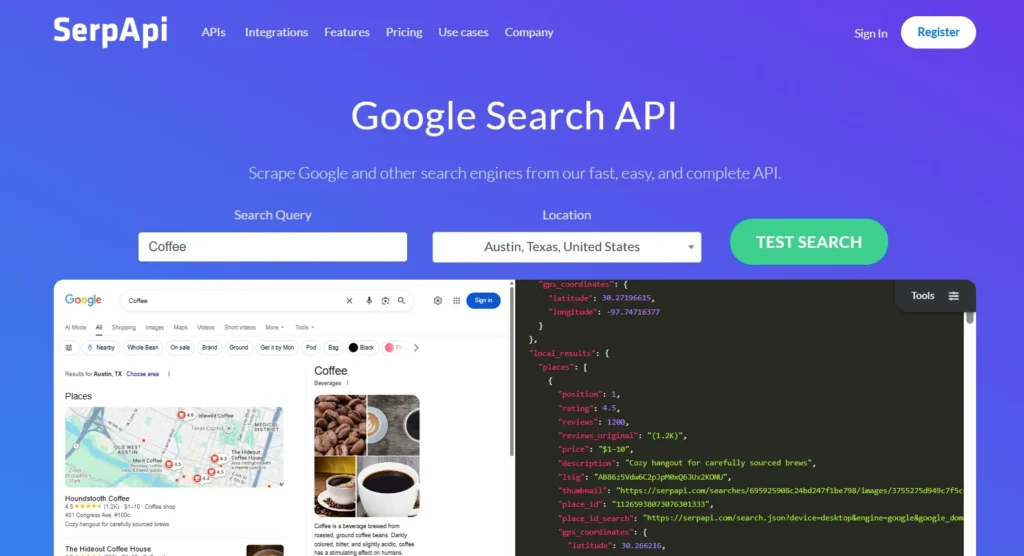
Forty-one times DataForSEO’s entry rate. Let me be fair about what that buys.
Every plan carries a “U.S. Legal Shield.” SerpApi takes on the legal exposure of the scraping. For a US company with a general counsel who asks uncomfortable questions, that line item is the entire product. I’ve sat in the meeting where this came up, and the $25 stopped being the issue within ninety seconds.
The engine list is also the widest for commerce: Google, Amazon, Apple, Baidu, Bing, DuckDuckGo, eBay, Facebook, Instagram, Naver, OpenTable, Tripadvisor, Walmart, Yahoo, Yandex, Yelp, YouTube and Zillow.
Throughput scales 50/hr free, 200 Starter, 1,000 Developer, 3,000 Production, 6,000 Big Data. Free tier is 250 searches a month, ongoing — not a trial, a permanent free plan. Month to month, cancel anytime.
At 30,000 searches the rate drops to $9.17, which is competitive with SearchAPI’s mid-tiers. The $25 entry rate is the outlier, not the whole story.
Would I pay it?
For my own work, no. For a client whose legal department needs indemnity, without hesitation.
The Two I Couldn’t Price
I’m not putting a made-up number in a comparison table. Here’s what’s missing and why.
ZenRows has no dedicated SERP API. Everything runs on one credit pool at $0.36 down to $0.09 per 1,000 credits (Build $16/45,000 up to Scale $456/5M).
But Google requests consume more than one credit once premium proxies and JS rendering apply, and the multiplier isn’t published. So the headline credit rate is not a per-SERP rate and I won’t present it as one.
Worth knowing anyway. Only successful requests are billed, and 404s and 410s count as usable.
Free tier is 5,000 credits with no card and no rollover. Concurrency runs 5 to 400+, and annual saves 17%.

ScrapingBee never publishes the credit cost of a Google Search API call, so the figure can’t be computed from public data.
Plans run Hobby $19, Freelance $49, Startup $99, Business $249, Business+ $599, all excluding VAT.
Their own plan pages disagree with their pricing page on credit totals — 7,500 versus 75,000 on Hobby. Free tier is 1,000 credits, no card.
Both are decent scrapers. Neither is transparent enough to buy as a SERP API without a sales conversation.
The Gotchas Nobody Puts in the Comparison Post
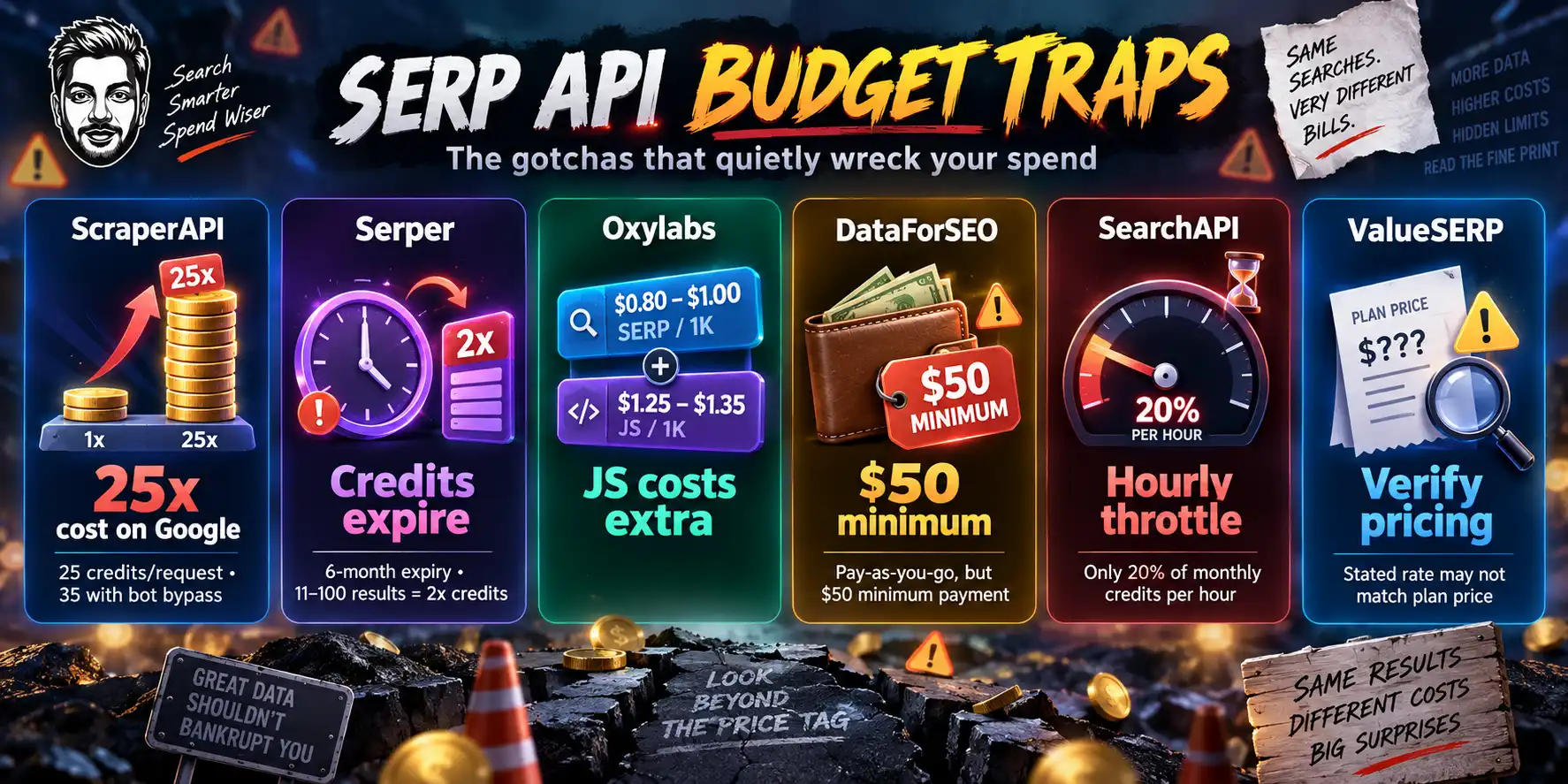
Collected in one place, because these are what actually blow up a budget.
AI Overview coverage is thin across the board. Only DataForSEO exposes a Google AI Mode endpoint. Only SearchAPI.io queries ChatGPT, Gemini and Perplexity directly.
SerpApi, Bright Data, ValueSERP, Oxylabs, ScraperAPI, ScrapingBee and ZenRows publish nothing AI-search-specific. If GEO work is on your roadmap, that narrows your shortlist to two.
What I’d Actually Pick
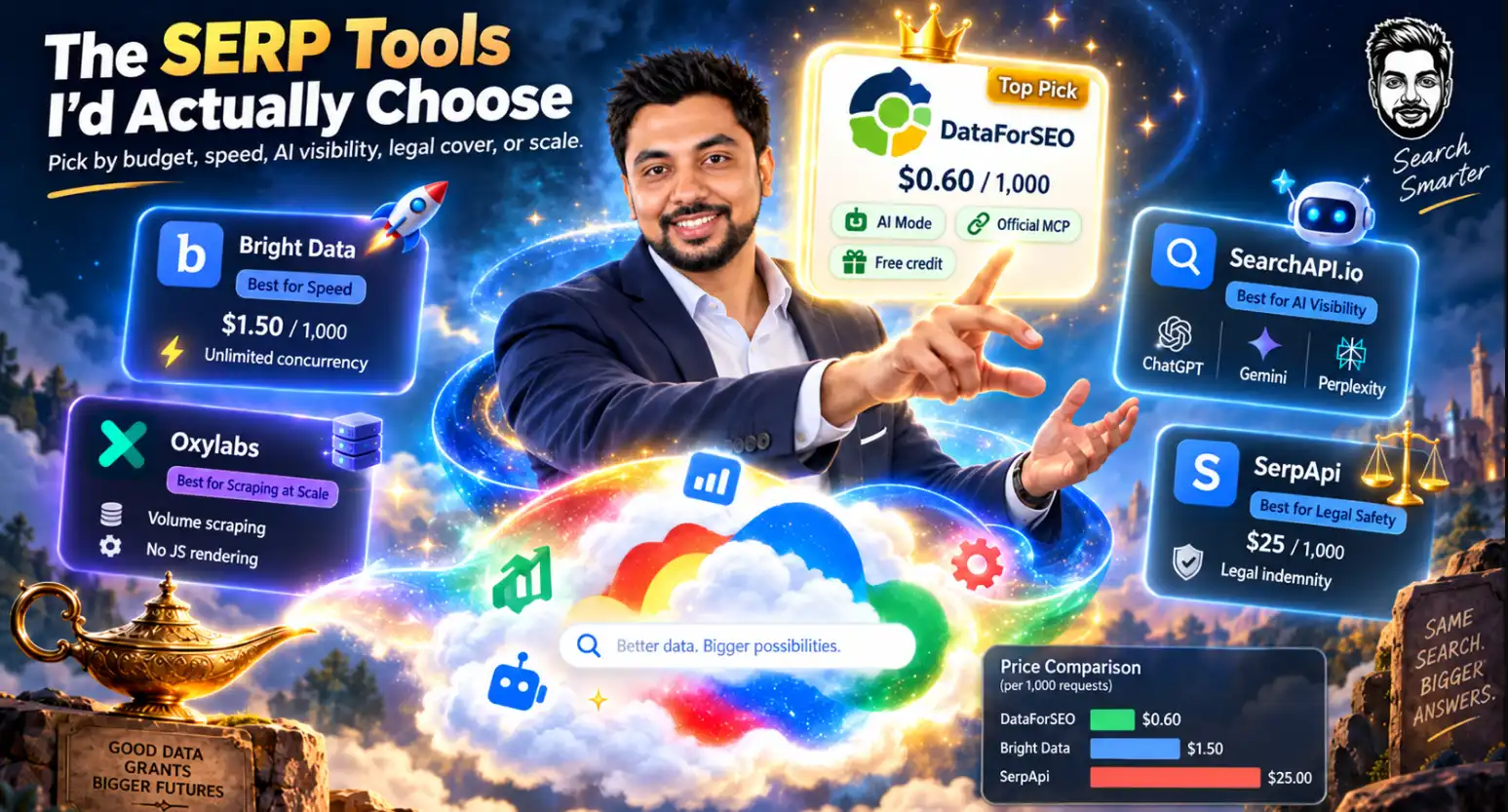
Who Shouldn’t Buy a SERP API At All
Two Questions
DataForSEO or SerpApi?
Cost versus indemnity. DataForSEO is 42x cheaper at entry. SerpApi carries US legal cover. If that sentence didn’t make you think of a specific person at your company, buy DataForSEO.
Can I use these for AI Overview tracking?
Only DataForSEO, via its Google AI Mode endpoint, or SearchAPI.io via its direct AI-engine endpoints. Everything else means scraping AI answers yourself, which is unreliable and gets you rate-limited.

Aliakbar Fakhri
The founder of AFFINCO
The Move
Convert every quote you get into cost per 1,000 before you compare anything. Vendors won’t do it for you, and that’s the point.
Start on DataForSEO’s free dollar. It doesn’t expire, so there’s no clock forcing a bad decision.
Evidence beats hype. Every time.
Related: if you need full pages rather than search results, see web scraping API pricing at 1M pages and Firecrawl alternatives compared.
Affiliate Disclosure: This post may contain some affiliate links, which means we may receive a commission if you purchase something that we recommend at no extra cost to you. Commissions never change our testing or recommendations.
Similar Posts






About the author:
Aliakbar Fakhri
Founder & CEO of AFFiNCO
I’m Ali. Since 2014 I’ve been building and scaling SEO, affiliate and AI growth systems, today across 29+ live domains.
Every strategy on this blog was tested on my own sites and budgets before it reached you. No guru fluff. Just what actually works.