
Web Scraping API Pricing 2026: 9 APIs Priced at 1M Pages

By
Ali
November 11, 2026
Every scraping API looks affordable on the pricing page.
Then you model a million pages a month and the numbers separate by a factor of more than seventy.
That’s what this article is. Not a feature comparison — one scenario, priced nine ways. A million pages a month, mixed targets, some requiring JavaScript rendering, some sitting behind Cloudflare.
I run AFFiNCO. We push serious scraping volume for competitive research and client work, and this modelling exercise is one I redo every quarter because the vendors keep changing the multipliers.
💵 One Million Pages, Nine Bills
| API | Monthly cost at 1M pages | Effective per 1,000 | Notes |
|---|---|---|---|
| ZenRows Growth | ~$165 | ~$0.14/1k credits | Credit multiplier unpublished |
| Firecrawl Scale | $599 | $0.60 | Clean markdown output |
| Apify (mid-range actor) | ~$130–2,000 | Varies wildly | Depends entirely on actor |
| ScraperAPI Startup | $149 | $0.15 general | $3.73 if Google |
| Oxylabs Advanced | ~$800 | $0.80 Google | +$1.25–1.35/1k for JS |
| Bright Data Scale | ~$1,310 | $1.31 | Unlimited concurrency |
| SearchAPI Octo 1M | $1,500 | $1.50 | Has AI-engine endpoints |
| SerpApi Big Data | $9,170 | $9.17 | US legal shield |
| ScraperAPI Hobby | $12,250 | $12.25 | If you scrape Google on Hobby |
Same job. $165 to $12,250.
The gap isn’t quality. It’s three things nobody puts on a pricing page.
Credit multipliers. Rendering surcharges. And whether failures are billed.
Let me take those apart, because understanding them is worth more than any recommendation I could give you.
The Three Things That Actually Set Your Bill
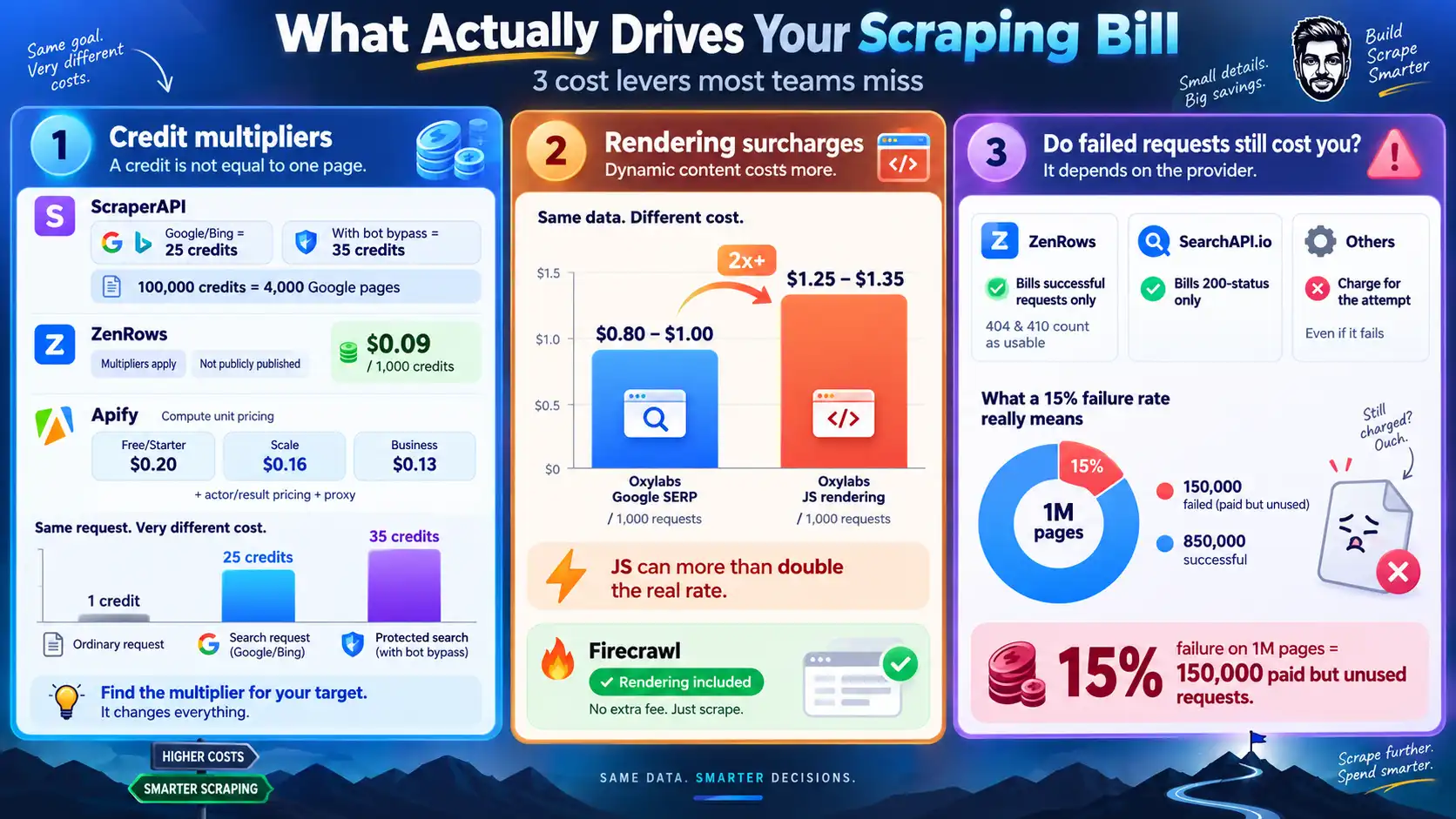
1. Credit multipliers
A “credit” is not a page. This is where most budgets die.
Before you compare anything, find the multiplier for your targets. It’s the only number that matters.
2. Rendering surcharges
JavaScript rendering is where the second surprise lives.
Firecrawl includes rendering in the credit. That single difference is worth more than a lot of headline discounts.
3. Whether failures cost you
The policy that separates the honest from the rest.
At a 15% failure rate on a million pages, that’s 150,000 requests you’re paying for and not using. Model it.
The APIs
1. Firecrawl — best output quality per dollar
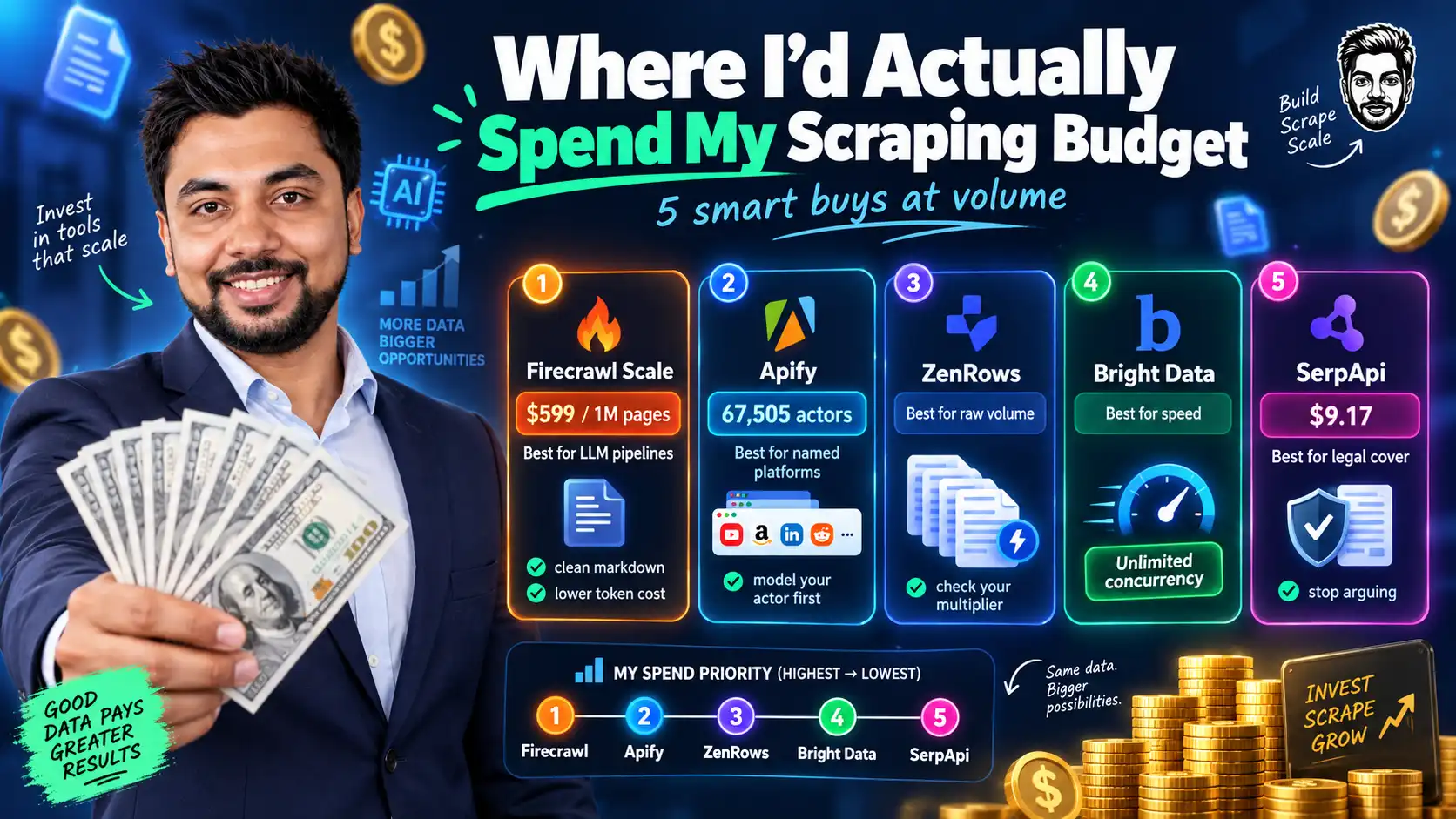
A million pages for $599. Sixty cents per thousand, rendering included, no credit multiplier games.
But the price isn’t why it’s the centre of my stack. Firecrawl returns clean markdown, not raw HTML. That sounds cosmetic until you feed a million pages into an LLM.
HTML burns roughly three times the tokens for the same information.
When you price scraping for AI workloads, the token cost downstream can exceed the scraping cost. Firecrawl is cheaper twice.
The official MCP server at mcp.firecrawl.dev/v2/mcp — keyless, OAuth or API key — means Claude scrapes in conversation with no integration written. That’s the reason I chose it over a marginally cheaper competitor and I’d make the same call again.
Free tier is 1,000 credits, enough to test properly.
Get started with Firecrawl and receive 1,000 free credits to explore its powerful web scraping and crawling capabilities.
2. Apify — platform coverage nothing else has
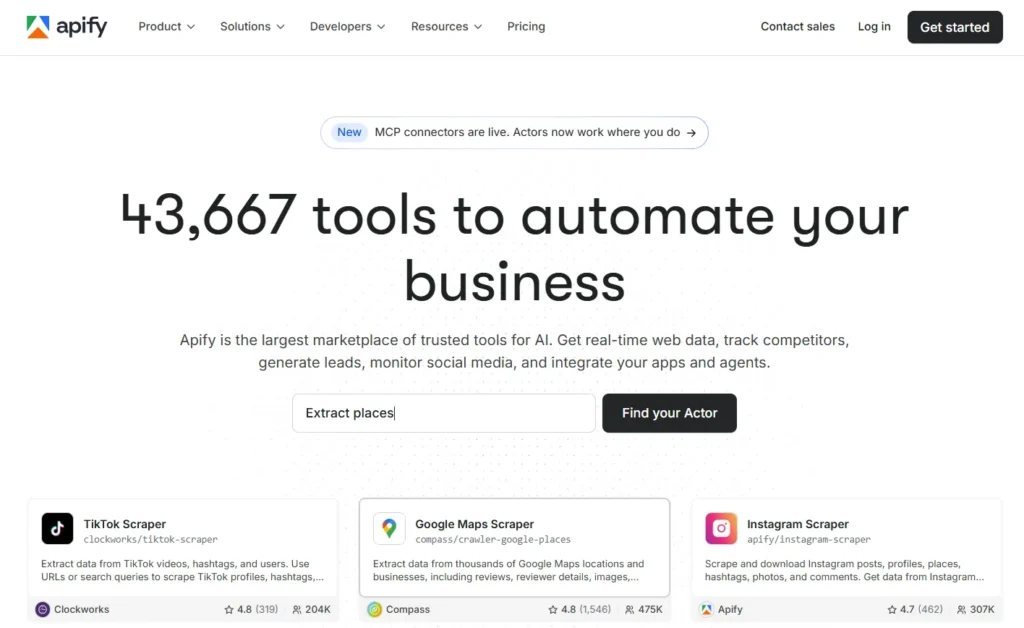
Apify isn’t really competing with Firecrawl. It’s competing with the three weeks you’d spend writing an Instagram scraper.
67,505 ready-to-run actors. When the job is TikTok, Instagram, Google Maps, LinkedIn or a marketplace, somebody has already solved it, maintained it through the last three anti-bot updates, and priced it per result.
The economics are genuinely hard to model, which is my main criticism. Subscription converts 1:1 into store credit, compute units run $0.13–$0.20, actors add their own per-result rates, proxy bills separately. A million pages might cost $130 or $2,000 depending entirely on which actor.
And credits don’t roll over. Apify’s docs are explicit: unused credit is gone at the end of the cycle. On a $999 Business plan, a quiet month is a real loss.
Run the actor on 1,000 results first and extrapolate. Don’t trust the plan price.

3. ZenRows — cheapest credits, unknown per-page cost
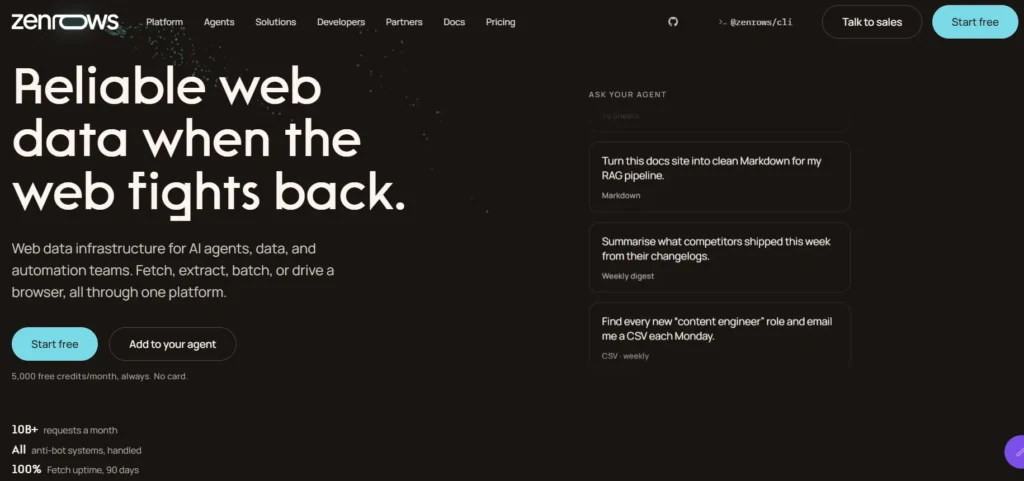
On paper this is the cheapest API here — $0.14 per 1,000 credits at Growth, $0.09 at Scale.
I’ve put it at the top of my table and I’m still not calling it the winner. The credit multiplier for premium proxies and JS rendering isn’t published.
Your real cost per page is unknown until you measure it on your own targets.
Two policies I do rate highly. Only successful requests are billed. And 404s and 410s count as usable results rather than wasted credits, which is a more honest definition of success than most.
Concurrency scales 5 → 400+, annual saves 17%, free tier is 5,000 credits with no card and no rollover.
Use the free tier to establish your actual multiplier. Then decide. That’s not a hedge — it’s the only responsible way to buy this one.
4. ScraperAPI — two completely different products in one bill
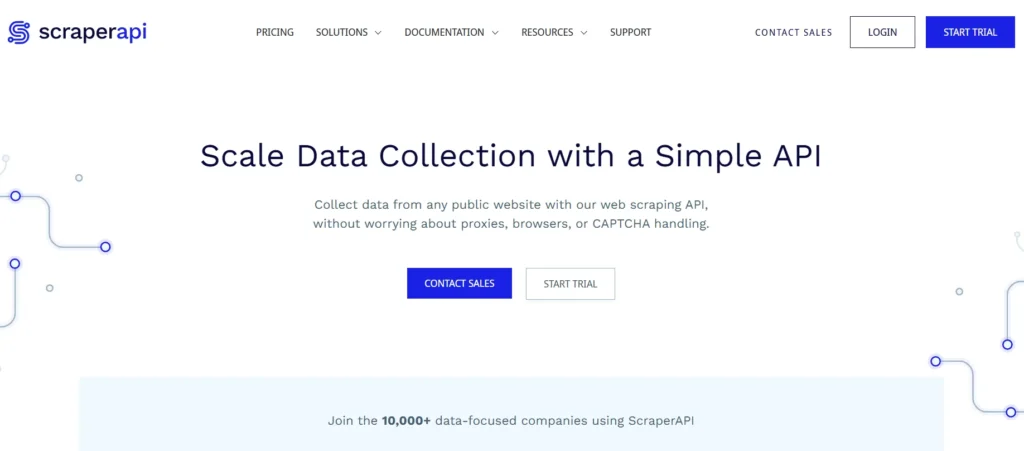
You have to split this one in half to evaluate it honestly.
- As a general scraper, where one request costs one credit, Startup at $149 for a million requests is $0.15 per 1,000 — genuinely competitive, with 50 concurrent threads.
- As a Google scraper, it’s the most expensive option in this article. 25 credits per request takes Startup to $3.73 per 1,000, and Hobby to a brutal $12.25.
So: excellent for general web, never for search engines. That’s not a criticism, it’s a scoping instruction.
Other things to know. Credits reset on renewal — no rollover. The free trial contradicts itself between the banner (5,000 credits, 7 days) and the FAQ (1,000 credits, 5 concurrent); trust the FAQ. Annual saves 10%.
5. Bright Data — buy it for concurrency, not for price
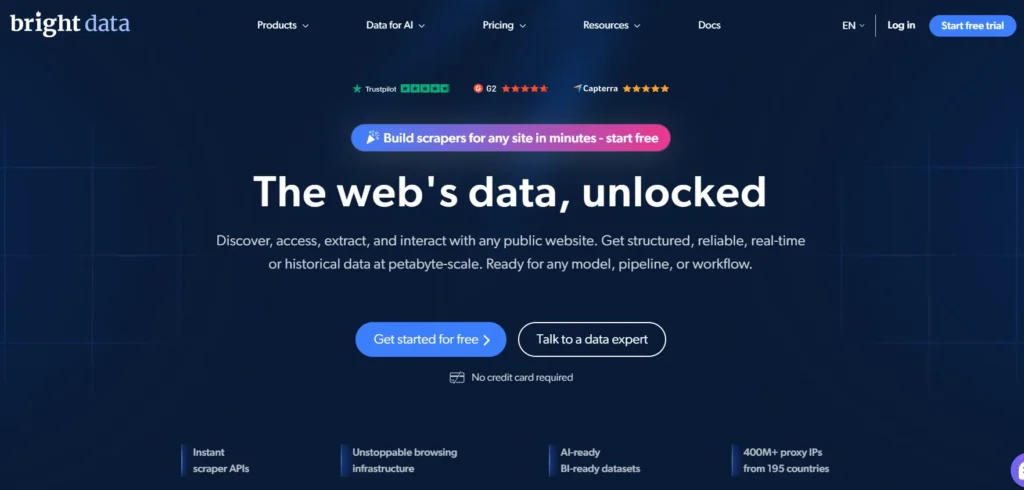
Bright Data isn’t cheap and doesn’t try to be. What it sells is unlimited concurrency on every plan, including pay-as-you-go.
That matters for one specific shape of job. If you need 50,000 pages in twenty minutes rather than 50,000 pages this week, concurrency is your constraint and price isn’t. Every other vendor throttles — Oxylabs at 10–50 req/s, SearchAPI to 20% of monthly credits per hour, ScraperAPI to 20–500 threads.
Free tier is 5,000 requests a month, no card — the largest ongoing free allowance here.
Two warnings. The nav advertises “from $1/1k req” but PAYG is actually $1.50; $1.30 needs the $499/mo Scale plan. And on residential, the widely-quoted $4/GB is a 50% coupon lasting three months — month four is $8.
It also bans ad and click fraud, fake engagement, fake accounts, posting to classified sites, crypto and NFT trading, streaming domains, and collecting data behind a login. Reselling proxies needs written approval.
Read that list properly before you architect anything on them.
6. Oxylabs — predictable, until you need rendering
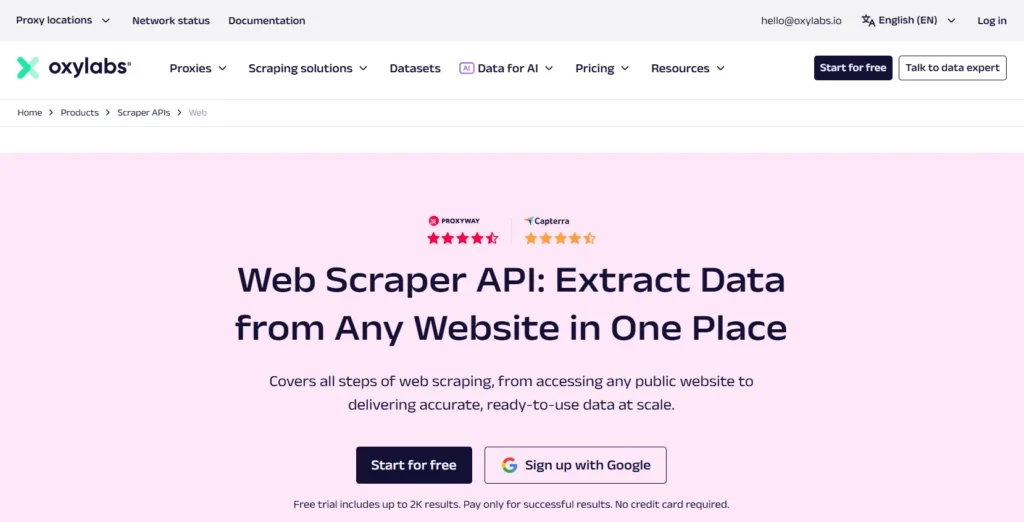
Pricing by target is honest about cost structure, and I wish more vendors did it.
The trap is rendering. JavaScript rendering costs an extra $1.25–$1.35 per 1,000 — more than the page itself. Media downloads add $2–$3 per GB. If your targets are modern JS applications, model at the combined rate or you’ll be out by more than double.
Rate limits: Micro is capped at 10 req/s, Starter and Advanced go to 50. Free trial is up to 2,000 results, no card.
All paid plans include 24/7 support and a dedicated account manager, which is worth something at 2am when a pipeline breaks before a client report.
Upto 50% OFF Oxylabs Coupon Codes
Save up to 50% on Oxylabs with code OXYLABS50, or use OXYLABS40 for 40% off and OXY30PREMIUM for 30% off. Choose the code that matches your plan and start saving
SearchAPI.io and SerpApi — the specialist picks
SearchAPI.io: Developer $40/10,000 ($4.00/1k) up to Octo 1M $1,500 ($1.50).
Mid-priced, and it does something nobody else does — dedicated ChatGPT, Gemini and Perplexity endpoints alongside 60+ other APIs.
If you’re building AI-visibility tooling rather than buying it, this is your source. Only 200-status responses are billed.
The throttle is 20% of monthly credits per hour, so no bursting a month into an afternoon.
SerpApi: Starter $25/1,000, down to $9.17 at 30,000. The most expensive here by a distance, and it has real customers for one reason — every plan carries a US Legal Shield.
SerpApi absorbs the legal exposure of the scraping. For a US company whose counsel asks uncomfortable questions, that line item is the entire product.
Free tier is 250 searches a month, permanently.
What I’d Actually Buy at Volume
Who Should Not Buy a Scraping API
I turn readers away in every roundup. Here’s this one’s list.
Two Questions
Firecrawl or Apify?
Firecrawl for arbitrary pages you want as clean markdown. Apify for named platforms where an actor already exists. I run both and they’ve never overlapped on a single job.
Why is my scraping bill triple my estimate?
Three usual suspects, in order: a credit multiplier you didn’t know about, a rendering surcharge, and paying for failed requests. Check all three before you switch vendor — most of the time you’re on the right tool with the wrong assumptions.

Aliakbar Fakhri
The founder of AFFINCO
The Move
Model one million pages before you buy anything, using your real targets and your real failure rate.
The pricing page number and your actual bill are different numbers, and the gap is where the whole decision lives.
Evidence beats hype. Every time.
Related: for Google results specifically, see the best SERP APIs compared by cost, and for AI-ready crawling, Firecrawl alternatives.
Affiliate Disclosure: This post may contain some affiliate links, which means we may receive a commission if you purchase something that we recommend at no extra cost to you. Commissions never change our testing or recommendations.
Similar Posts




About the author:
Aliakbar Fakhri
Founder & CEO of AFFiNCO
I’m Ali. Since 2014 I’ve been building and scaling SEO, affiliate and AI growth systems, today across 29+ live domains.
Every strategy on this blog was tested on my own sites and budgets before it reached you. No guru fluff. Just what actually works.