
Firecrawl Alternatives 2026: 9 Tools Compared on Real Pricing

By :
Ali
August 26, 2026

⚡ Quick Answer: The best Firecrawl alternatives in 2026 are Apify (largest actor marketplace, most cost-effective at scale), Crawl4AI (free, open-source, self-hosted), Bright Data (enterprise proxy and unblocking infrastructure), ScrapingBee (cheapest per page on easy sites), Nimble (deepest native Claude integration), and TinyFish (free Search and Fetch APIs, live results, never cached).
Honest verdict after running all of them across a 29-domain portfolio: Apify is the alternative we actually kept, but Firecrawl at $19–$749 per month remains our primary web scraping API for AI agents, because no competitor ships search, scrape, crawl, interact, monitor and extract behind one credit system with a native MCP server.
Let me start with the uncomfortable part.
You searched “Firecrawl alternatives.” I have spent the last eight months running Firecrawl across my properties, and my honest first reaction to that query is a question back at you: why?
I am not being difficult. I run AFFMaven, AFFNinja, AFFMashup and a stack of other sites. We build AI applications, internal dashboards, comparison engines, affiliate databases. Scraping is not a nice-to-have in that operation. It is the foundation. Without fresh structured web data, our entire content and product machine stops moving.
So I have tested this category properly, with real invoices, not a free trial and a blog post. And after all of it, Firecrawl is still the tool I pay for first every month.

What We Actually Run (So You Know Where This is Coming From)
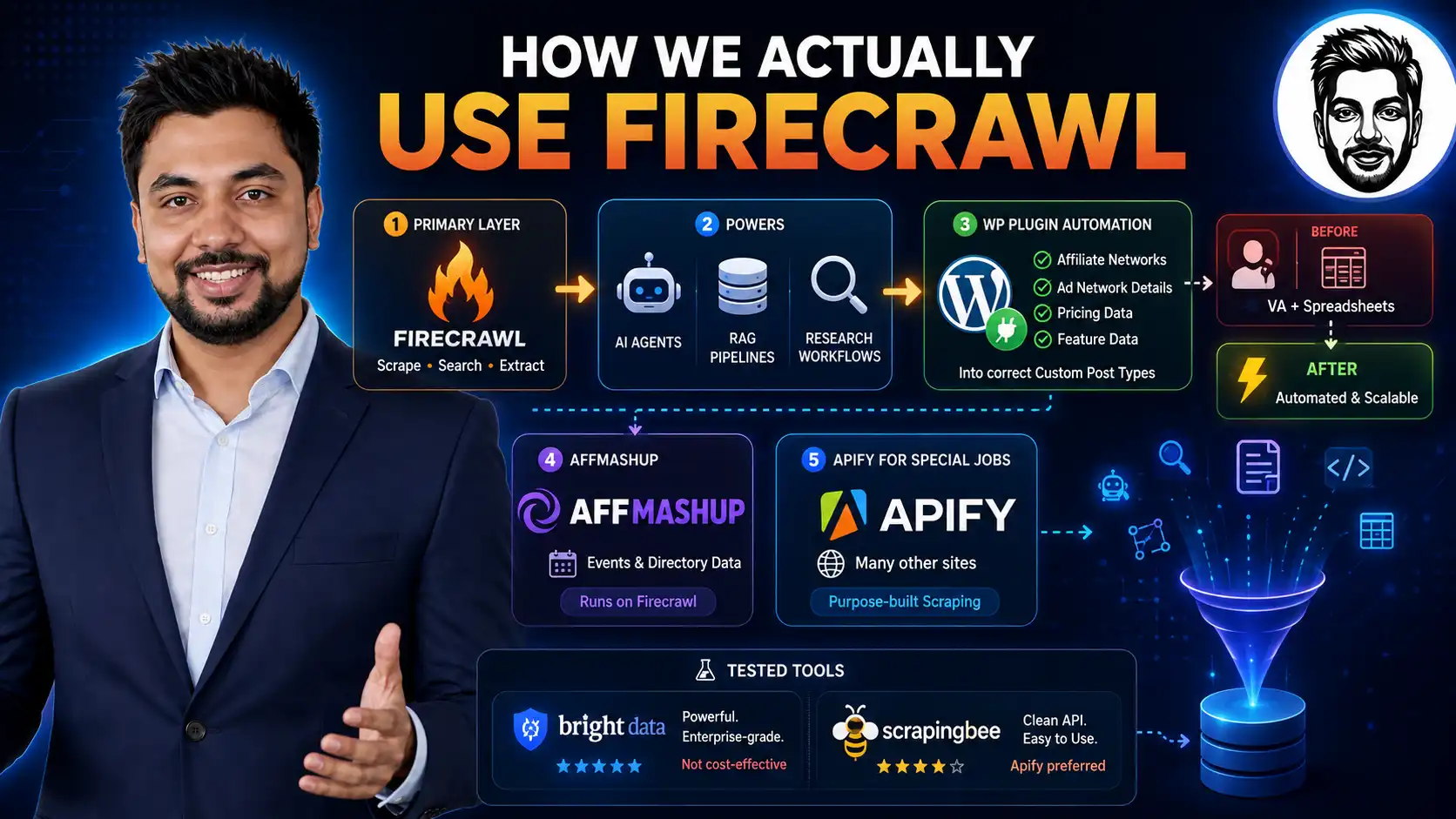
Context matters, because most “Firecrawl alternatives” posts are written by companies selling you the alternative.
Here is our real setup.
That is the honest ledger. Now let us go through the market.
First, Understand What Firecrawl Actually Is in 2026
This is the single biggest problem with every Firecrawl comparison you will read today. Most of them are comparing against the 2024 product. Firecrawl in mid-2026 is a different company.
Here is what is actually shipping, verified against their own docs and changelog:
| Product | What it does |
|---|---|
| Scrape | Single URL to clean markdown, HTML, JSON or screenshot |
| Crawl | Whole-site extraction with depth and path control |
| Map | Fast URL discovery across an entire domain |
| Search | Web search returning answer-bearing excerpts, not just links |
| Interact | Real browser actions — click, type, scroll, log in |
| Monitor | Change tracking with AI judging, launched May 2026 |
| Agent | Autonomous extraction, URLs optional, powered by their own models |
| Parse | Any document, including PDFs, into LLM-ready data |
| Browser | Secure cloud browser sandboxes for agents |
The Monitor product is the one people keep missing. It watches a page, a whole website, or the entire web via recurring search, diffs the result, runs an AI judge against a plain-English goal such as “alert me when pricing changes,” and pushes to webhook, email or Slack.
Minimum interval is five minutes. For competitive intelligence in affiliate marketing, that is not a feature, that is a full product we would otherwise have paid a separate SaaS for.
Then there is the developer surface, which is where Firecrawl quietly pulled ahead:
They also became the first company in this category to sign a paid data partnership with Wikimedia Enterprise, routing and paying for all Wikipedia traffic through the official API rather than hammering it for free. Nobody writes about that. It tells you something about how they intend to operate.
The scale numbers, from their own site: 150,000+ companies, 1.25 million developers, 5 billion+ requests served, 2.5 million weekly SDK downloads, roughly 157,000 GitHub stars. Customers on the logo wall include Shopify, Canva, Apple, Alibaba, DoorDash, Zapier, Replit, Lovable, Sierra, You.com and Gamma.
Backing: Y Combinator S22, a $14.5 million Series A led by Nexus Venture Partners in August 2025, total raised $16.2 million, with Shopify CEO Tobias Lütke and Postman CEO Abhinav Asthana on the cap table. TechCrunch reported the company was already profitable at the raise. The team originally went through YC as SideGuide, pivoted to Mendable, and landed on Firecrawl.
The Pricing Mistake Almost Every Article Makes
Firecrawl’s pricing page defaults to the annual view. Blogs scrape that number and publish it as the monthly price. It is wrong everywhere.
| Plan | Monthly | Annual equivalent | Credits/month | Concurrency |
|---|---|---|---|---|
| Free | $0 | $0 | 1,000 | 2 |
| Hobby | $19 | $16 | 5,000 | 5 |
| Standard | $99 | $83 | 100,000 | 50 |
| Growth | $399 | $333 | 500,000 | 100 |
| Scale | $749 | $599 | 1,000,000 | 150 |
Credits are refreshingly simple: 1 credit per page for scrape, crawl and map. Search costs 2 credits per 10 results. Interact costs 2 credits per browser minute. Monitor costs 1 credit per page per check.
At Standard, that is $0.99 per 1,000 pages. At Scale, $0.75 per 1,000 pages. Hold that number, because it is the benchmark every alternative below gets measured against.
When You Genuinely Should Look Elsewhere
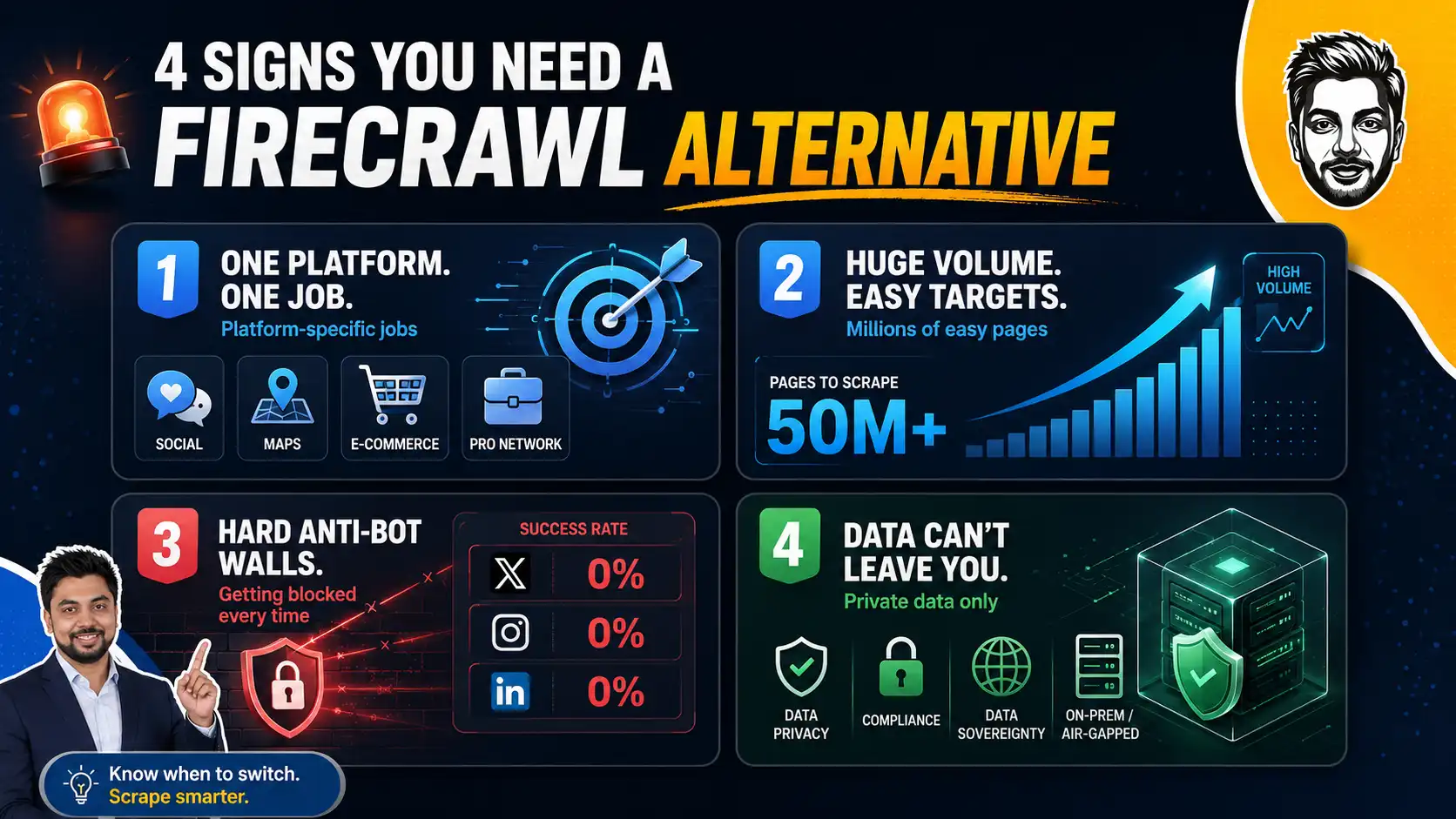
I am not going to pretend Firecrawl wins every scenario. Four situations where it does not:
- You need a scraper for one specific platform. Instagram, Google Maps, LinkedIn, Amazon. A purpose-built scraper beats a general crawler every time.
- Your volume is enormous and your targets are easy. If you are pulling millions of simple pages, per-page pricing stops being the cheapest model.
- You are blocked by hard anti-bot systems. Independent benchmarking shows Firecrawl scoring 0% on Twitter/X, Instagram and LinkedIn. That is not a criticism, it is a boundary.
- You cannot send data to a third party. Compliance, sovereignty, or an air-gapped environment.
Each of those maps to a different tool below.
Firecrawl Alternatives Compared: Real Cost Per 1,000 Pages
Before the individual breakdowns, here is the whole market normalized. Every figure is from the vendor’s public pricing page, July 2026.
| Tool | Pricing model | Entry price | Cost per 1,000 easy pages | Cost per 1,000 hard pages | Self-host |
|---|---|---|---|---|---|
| Apify | Compute units + actor fees | $29/mo | ~$1–$10 per 1,000 results | Actor-dependent | No |
| Crawl4AI | Free software, you rent infra | $0 + server | ~$0.10–$0.30 blended | Proxy cost dominates | Yes (Apache-2.0) |
| Bright Data | Per 1K requests + per GB | Free 5K/mo | $0.98–$1.50 | $1.30–$1.50 | No |
| ScrapingBee | Credits, multiplied by difficulty | $49/mo | $0.20 | $14.70 (stealth) | No |
| Nimble | Per 1K URLs by driver | Free 5K pages | $0.90 | $1.45 | No |
| TinyFish | Free fetch, pay per agent step | $0 / $15/mo | $0.00 | Agent credits apply | No |
| Zyte | Per request by difficulty tier | $5 trial | $0.13 | $16.08 (browser, advanced) | No |
| ScraperAPI | Credits with domain multipliers | $49/mo | $0.15 | $4.50+ (LinkedIn) | No |
| Scrape.do | Credits, charged only on success | $29/mo | $0.08 | $2.00 | No |
Look at the spread on that “hard pages” column. $0.99 to $16.08. That single column explains why this category confuses people.
Firecrawl charges one flat credit whether the page is a static blog or a Cloudflare-hardened storefront. Almost everybody else prices difficulty. If your targets are easy, difficulty pricing is far cheaper. If your targets are mixed and unpredictable, flat pricing is the only way to forecast a bill.
1. Apify — The Alternative We Actually Kept
Apify is not really a Firecrawl competitor. It is a different shape of product, and understanding that difference is the whole game.
Firecrawl sells you one excellent general-purpose crawler. Apify sells you a marketplace of thousands of purpose-built scrapers, called Actors, each written for a specific site. You need Google Maps listings with reviews and opening hours? There is an Actor. Instagram profiles? Actor. Amazon product pages, LinkedIn companies, TikTok, Shopify stores, job boards? All Actors.
That is why we run Apify across a lot of our sites. When the job is “get me every business in this category from Maps, with ratings and phone numbers,” a general crawler is the wrong tool. Somebody already solved that exact problem and maintains the solution.
Apify vs Firecrawl Pricing
| Apify plan | Monthly | Credits included | CU rate | Concurrent runs |
|---|---|---|---|---|
| Free | $0 | $5/mo | $0.20/CU | 25 |
| Starter | $29 | $29/mo | $0.20/CU | 32 |
| Scale | $199 | $199/mo | $0.16/CU | 128 |
| Business | $999 | $999/mo | $0.13/CU | 256 |
Ten percent off annual. Store Actors typically charge $1 to $10 per 1,000 results on top of platform compute.
Here is the honest catch, and it is the thing nobody warns you about: Apify bills overage on top of your plan. Real spend routinely lands well above the sticker price, because compute units and Actor fees stack. Firecrawl’s credit bucket is a ceiling. Apify’s plan is a floor. Budget accordingly.
Where Apify Genuinely Beats Firecrawl
Where Firecrawl Wins
Firecrawl gives you clean LLM-ready markdown from any URL without hunting for the right Actor, and it does search, monitoring and browser interaction in the same credit system. Apify has no equivalent of Monitor. For AI agent work — which is most of what we build — that integration is worth more than per-row efficiency.
Verdict: Run both. We do. Firecrawl for the agent and research layer, Apify for platform-specific harvesting.
2. Crawl4AI — The Free One, With an Asterisk
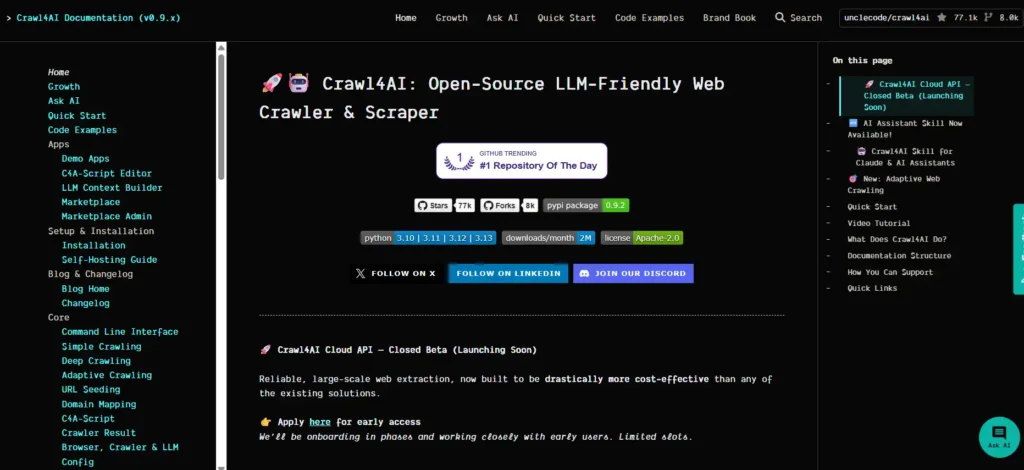
Crawl4AI is the open-source answer to Firecrawl, and it is a serious project: roughly 66,000 GitHub stars, Apache-2.0 licensed, actively maintained. It outputs clean markdown — including a noise-stripped “fit markdown” variant — plus HTML, PDF, screenshots and structured JSON.
Extraction is genuinely capable. You get CSS and XPath schema extraction that runs deterministically without an LLM, plus LLM-driven extraction against OpenAI, Anthropic, DeepSeek, Groq, Gemini and others. Chunking strategies for RAG are built in, including cosine-similarity content matching. The Docker server exposes MCP natively over SSE and WebSocket, so your agents can talk to it directly. There is a CLI.
For AI agent and RAG compatibility, it is the strongest open-source option in the category.
The Asterisk
“Free” is a licence, not a cost.
| Component | Real cost |
|---|---|
| Software licence | $0 |
| Server, 4 GB / 2 vCPU minimum | ~$24/mo |
| Server, 8 GB, realistic for browser pools | ~$48/mo |
| Residential proxies — not included | $3.50–$8.00 per GB |
| LLM API keys — not included | your own provider bill |
| Patching and maintenance | your engineer’s time |
That proxy line is where self-hosting budgets die. Crawl4AI gives you the crawler. It does not give you an unblocking network, an anti-bot service, or an SLA. Firecrawl’s cloud product includes all three inside that single credit.
The Docker container needs a minimum of 4 GB RAM and a 1 GB shared memory allocation for Chromium. And you own security: version 0.8.9, shipped June 2026, patched an SSRF vulnerability in the Docker API. On a managed platform, that is somebody else’s Tuesday.
Verdict: If you have engineers and mostly-easy targets at high volume, the maths favours Crawl4AI. If you are a marketing team, “free” will cost you more than $99 a month in the first week.
3. Bright Data — Powerful, and Honestly Too Expensive for Us
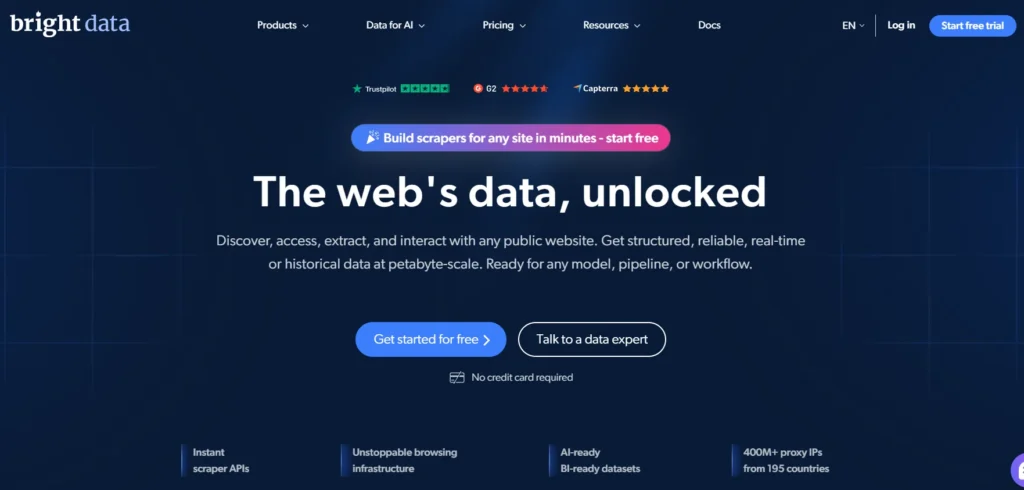
I want to be fair here, because Bright Data is not a bad product. It is arguably the most capable unblocking infrastructure on the market. It is simply built for a customer that is not us.
Bright Data sells the unblocking layer itself — a massive residential and datacenter proxy network — and layers products on top: Web Unlocker, SERP API, Web Scraper APIs, Crawl API, Browser API, ready-made Datasets.
Bright Data Pricing vs Firecrawl
| Product | Pay-as-you-go | Committed tier |
|---|---|---|
| Web Unlocker | $1.50 / 1,000 req | $499/mo → 383K req, then $1.30/1K |
| SERP API | $1.50 / 1,000 req | $499/mo → ~380K req |
| Crawl API | $1.50 / 1,000 records | $499/mo → 510K @ $0.98/1K |
| Residential proxies | $4.00/GB promo, $8/GB list | $499/mo → 141 GB @ $3.50/GB |
| Datasets | $0.0025/record | $250 minimum order |
| Managed services | — | $1,000/mo minimum + $500 setup + $4/1K |
To be precise, because precision matters: Bright Data has a real free tier — 5,000 requests a month, no credit card. Getting started is not the problem.
The problem is that every discounted tier across every product starts at the same $499 per month floor, managed work carries a contractual $1,000 per month minimum, and the vertical products begin at $1,500 to $2,000 per month. Below $499 committed, you pay full rack rate.
We ran the numbers against our actual usage and the answer was not close. We were paying enterprise infrastructure prices for volumes that Firecrawl’s $99 Standard plan absorbs without noticing.
Company context, because it is a genuinely serious business: founded 2014 as Luminati Networks, renamed Bright Data in 2021, acquired by EMK Capital in 2017 at roughly a $200 million valuation. They have also won the landmark scraping cases — Meta v. Bright Data went their way in January 2024, and X Corp’s suit was dismissed in May 2024. If your legal team needs comfort on scraping precedent, that history is worth something.
Verdict: Correct choice above roughly $500 a month in committed spend, on hard targets, at enterprise scale. Wrong choice for everybody else, and the price is the reason we left.
4. ScrapingBee — Cheapest Per Page, If Your Pages Are Easy
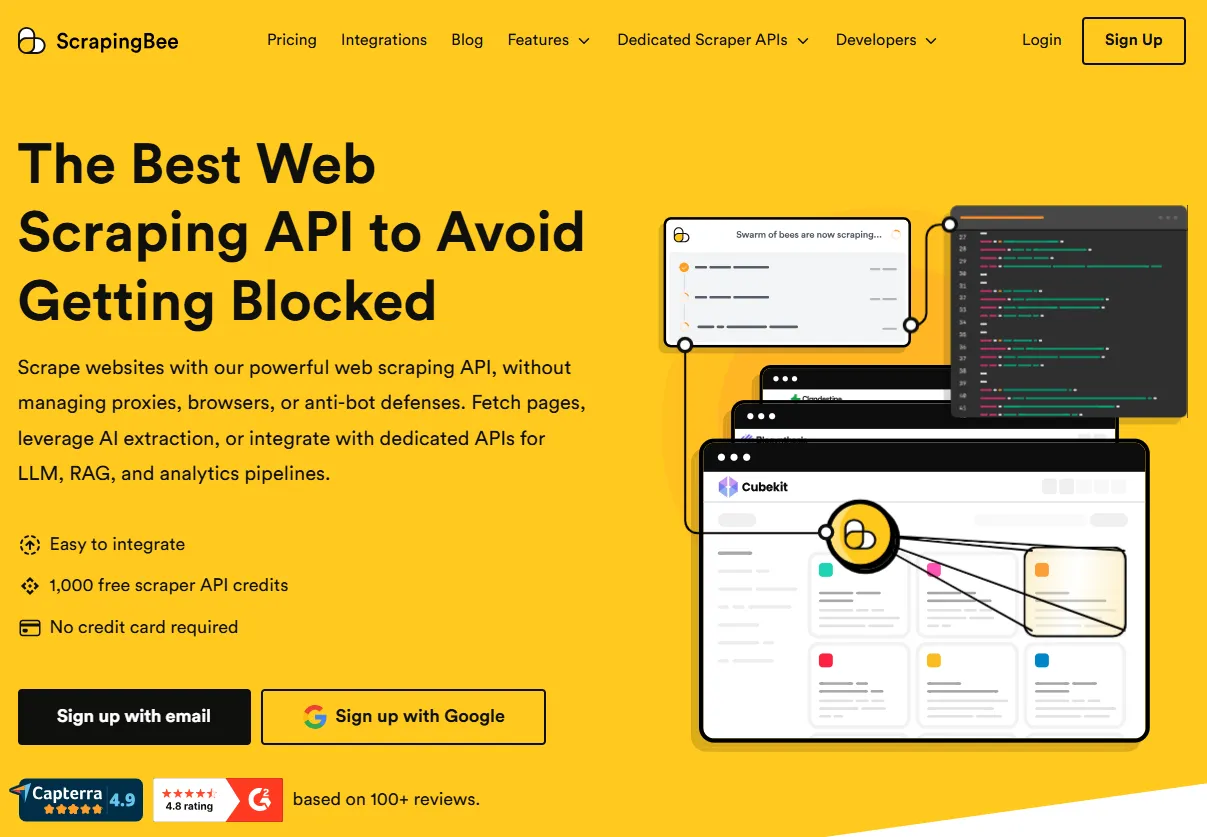
ScrapingBee is a clean, well-built API from a small bootstrapped French team — founded 2019 by Kevin Sahin and Pierre de Wulf, funded through TinySeed rather than venture capital. We tested it, we liked it, and we still went back to Apify. Here is the honest reasoning.
| Plan | Monthly | API credits | Concurrency |
|---|---|---|---|
| Freelance | $49 | 250,000 | 50 |
| Startup | $99 | 1,000,000 | 100 |
| Business | $249 | 3,000,000 | 200 |
| Business+ | $599 | 8,000,000 | 400 |
The headline numbers look devastating for Firecrawl. A million credits for $99 versus Firecrawl’s 100,000. But credits are not pages, and this is where you have to read the fine print.
ScrapingBee credit multipliers:
| Request type | Credits |
|---|---|
| Classic proxy, no JS | 1 |
| Classic proxy + JS rendering | 5 |
| Premium proxy, no JS | 10 |
| Premium proxy + JS | 25 |
| Stealth proxy | 75 |
| Google search targeting | 20–75 |
At Freelance, credits cost $0.196 per 1,000. So a plain page is $0.20 per 1,000 — five times cheaper than Firecrawl. But a stealth-proxy page is 75 credits, which works out to roughly $14.70 per 1,000 pages. That is a 75x spread inside the same account.
One genuinely good design decision: failed Auto-Mode requests cost zero credits. You only pay for the tier that succeeded.
Independent benchmarking from Scrapeway in July 2026 puts the trade-off plainly. ScrapingBee is faster and much cheaper — 2.8 seconds average response versus Firecrawl’s 4.5, and $1.51 per 1,000 requests versus $5.38 measured across their test set. But success rate was 43.6% for ScrapingBee against 69.3% for Firecrawl. You are buying cheaper requests that fail more often.
Verdict: Genuinely cheaper if you know your targets are easy. If your target list is mixed, the difficulty multipliers turn a predictable bill into a surprise.
5. Nimble — The Agent-Native One

Nimble is the most interesting new entrant in this comparison, and the least like Firecrawl in philosophy.
Firecrawl gives you an API and lets you wire it up. Nimble is built to be the agent’s web tool. They ship a first-party Claude connector that works across Claude web, desktop, mobile, Claude Code and the Claude API, plus an MCP server, a CLI, a LangChain connector, and an Agent Skills repository bundling 20-plus domain skills — company deep-dives, competitor intelligence, talent sourcing, SEO research, local business discovery, brand mention monitoring.
The product range is genuinely broad: Search, Extract, Map, Crawl, Web Search Agents with cited answers and confidence grading, a SERP API that uses computer vision to structure results, a Maps API that batches up to 1,000 zip codes per request, an E-commerce API, and templates for 50+ popular sites that survive layout changes. They market hard into pricing intelligence, digital shelf analytics, brand monitoring, influencer tracking and alternative data.
Nimble vs Firecrawl Pricing
| Nimble product | Price |
|---|---|
| Free tier | 5,000 pages |
| Extract / Crawl / Map — standard driver | $0.90 per 1,000 URLs |
| Extract / Crawl / Map — render JS | $1.30 per 1,000 URLs |
| Extract / Crawl / Map — JS + stealth | $1.45 per 1,000 URLs |
| Search API | $5 per 1,000 search inputs |
| Managed — Startup | $2,500/mo |
| Managed — Scale | $7,000/mo |
| Managed — Professional | $15,000/mo |
So on easy pages Nimble undercuts Firecrawl slightly, $0.90 against $0.99 per 1,000. On stealth it is $1.45 against Firecrawl’s flat $0.99 — still remarkably tight compared to ScrapingBee’s $14.70.
The managed tier is where the two diverge completely. Nimble’s entry managed plan is $2,500 a month. Firecrawl’s top self-serve plan is $749.
On the Claude numbers, since I have seen them quoted: Nimble’s homepage headlines “1.5M Claude Plugin Users.” Anthropic’s own plugin directory currently lists the Nimble plugin at 2,738 installs. Read the 1.5 million as ecosystem reach rather than Nimble’s install base. I am including the correction because this article is about checking numbers, and I would rather you heard it from me.
Company: founded 2021 by Uri Knorovich and Menachem Salinas, headquartered in New York with R&D in Israel, roughly 120 employees. They closed a $47 million Series B in February 2026 led by Norwest Venture Partners with Databricks Ventures participating, bringing total funding to $75 million. Named customers include LG, Deloitte, Uber, L’Oréal, Coca-Cola and Tripadvisor. SOC 2 compliant.
Verdict: The strongest choice if your entire workflow lives inside Claude and you want breadth of vertical APIs. Firecrawl’s Claude integration is excellent too, and $1,750 a month cheaper at the top self-serve tier.
6. TinyFish — The One Giving Away What Firecrawl Charges For
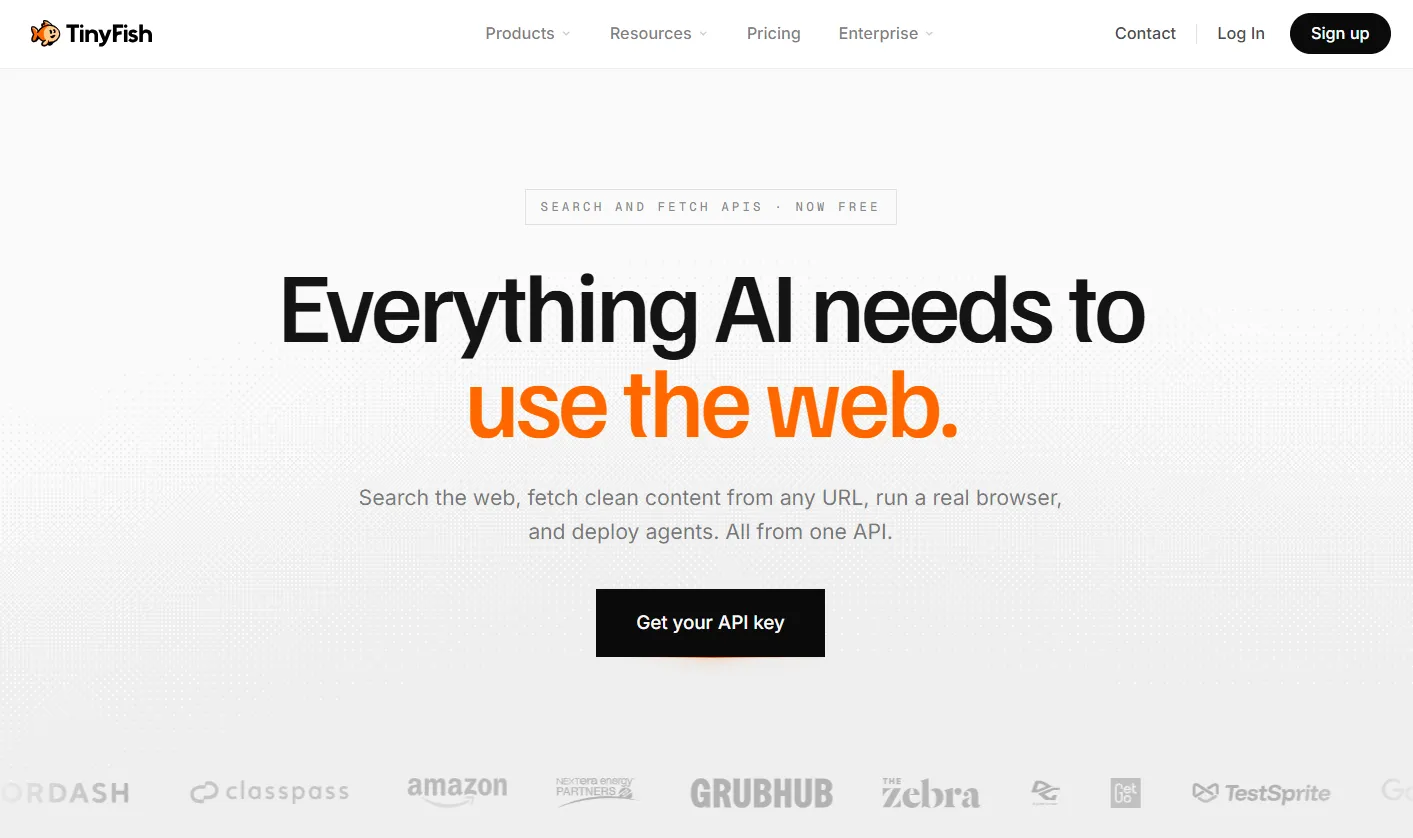
TinyFish is the most aggressive pricing move in this entire category, and almost nobody has written about it properly.
Their Search API costs 0 credits per request. Their Fetch API costs 0 credits per URL. Both are free within rate limits — 30 requests per minute for search, 150 URLs per minute for fetch.
That is the core Firecrawl product, given away. TinyFish monetizes only when the agent starts acting.
| TinyFish product | Cost |
|---|---|
| Search API | 0 credits |
| Fetch API | 0 credits |
| Agent API | 1 credit per step |
| Browser API | 1 credit per 4 minutes, 60 min cap |
| Pay-as-you-go | $0.015/credit, 500 free credits, no card |
| Starter | $15/mo — 1,650 credits |
| Pro | $150/mo — 16,500 credits |
Fetch renders in a real browser and returns clean markdown, JSON or HTML. Their positioning line is “Fresh results from the live web. Never cached,” contrasted against competitor data they describe as roughly six weeks old.
One accuracy note, because I checked the docs: the Fetch API does expose a cache-control parameter, so caching is available and opt-in rather than absent. Set it to zero for a genuinely live fetch. The freshness claim is about the default behaviour, and the default is live.
They also recommend connecting via MCP over the REST API — OAuth handles authentication, so there are no API keys to manage. Supported in Claude Code, Claude Desktop, Cursor, Codex, ChatGPT and Windsurf.
In July 2026 they shipped Mako, their own web-native model: 35 billion total parameters with 3 billion active at inference, trained on real authenticated multi-step enterprise web tasks. Alongside Firecrawl’s Spark models, that makes two companies in this category who now train their own.
Company: launched out of stealth in August 2025 with a $47 million Series A led by ICONIQ, with USVP, Mango Capital and MongoDB Ventures participating. Founded by Sudheesh Nair, former President of Nutanix, Shuhao Zhang, formerly of Meta, and Keith Zhai, formerly of the Wall Street Journal. Customers named include Google, DoorDash, Amazon, Grubhub and ClassPass.
Verdict: If you are cost-sensitive and your workload is mostly fetching and searching, TinyFish is very hard to argue with. The trade-off is maturity — Firecrawl has 150,000 companies and four years of production hardening behind it. TinyFish launched eleven months ago.
Also Worth Knowing
Three more that deserve naming, briefly.
Zyte is the oldest company in the category — founded 2010 as Scrapinghub by the creators of Scrapy, the framework much of this industry was built on.
Pricing bands explicitly by site difficulty: HTTP responses run $0.13 to $1.27 per 1,000, browser-rendered runs $1.01 to $16.08 per 1,000. That $16.08 top rate is the most expensive published number in this article.
They claim a 97.82% success rate and offer a $5 trial. Sixteen years of provenance counts for something.
ScraperAPI is the volume player — founded 2018, serving 10,000+ brands and a claimed 36 billion requests a month.
Plans run $49 to $1,975, and they publish the clearest per-domain credit table in the market: standard page 1 credit, Amazon 5, Google 25, LinkedIn 30, bot-protection bypass +10.
There is a cost estimator in the dashboard, so you can price a job before running it. Nobody else does that.
Scrape.do has the cheapest published entry point of the API vendors — $29 a month for 250,000 credits, roughly $0.11 per 1,000, dropping to $0.06 at the top tier.
Their free tier is unusually generous because it includes every premium feature: residential proxies, JS rendering, geo-targeting, CAPTCHA handling. And they only charge on success.
The multipliers are steep on hard domains — Shopee costs 100 credits, Sainsburys 200 — but they return the exact charge in a response header, so you always know.
The Honest Section: Where Firecrawl Actually Loses
I have spent this article defending Firecrawl. Here is the counterweight, from independent testing rather than vendor marketing.
Scrapeway runs continuous weekly benchmarks across twelve target sites. In the week of 18–24 July 2026, Firecrawl scored:
And the finding that matters most for anyone in affiliate or social work: Firecrawl hit 97% on realtor.com and 96% on amazon.com, but 0% on Twitter/X, Instagram and LinkedIn.
If your work depends on those three platforms, Firecrawl is the wrong tool and no amount of feature depth changes that. Use Apify’s platform-specific Actors, or Bright Data’s unblocking layer. That is exactly the situation these alternatives exist for.
Two more honest limitations. Self-hosted Firecrawl loses Fire-engine, their proprietary anti-bot layer, along with the /agent and /browser endpoints — so the free version is meaningfully weaker than the cloud one. And Extract is metered in tokens rather than credits, with no published per-extraction rate, which makes forecasting harder than the rest of their pricing suggests.
How to Choose, In One Pass
- You want one tool that does search, scrape, crawl, monitor and interact for AI agents → Firecrawl
- You need a ready-made scraper for a specific platform → Apify
- You have engineers, high volume, easy targets, and compliance requirements → Crawl4AI
- You are enterprise, hitting hard targets, above $500/month committed → Bright Data
- Your targets are simple and your volume is large → ScrapingBee or Scrape.do
- Your whole workflow lives inside Claude and you want vertical APIs → Nimble
- You want live, uncached results and the lowest possible bill → TinyFish
- You need to know the cost before you run the job → ScraperAPI
The Final Word
Here is what eight months of paying for this category taught me.
The web scraping market has split into two philosophies, and almost every comparison article misses it. One group sells you access — proxies, unblocking, per-GB bandwidth, difficulty tiers. Bright Data, ScrapingBee, Zyte, Scrape.do all live here. The other group sells you understanding — clean markdown, structured JSON, agent-ready output, change detection. Firecrawl, Nimble and TinyFish live here.
If you are still choosing on price per 1,000 pages, you are shopping in the first category while building in the second. That mismatch is why so many teams churn through four scrapers in a year.
We landed where we landed for a specific reason. Our operation does not need the cheapest page. It needs the page already understood — cleaned, structured, dropped into a WordPress custom post type, watched for changes, and handed to an agent that does something with it. Firecrawl collapses that entire chain into one API, one credit system and one MCP server. When we replaced our lead research process with a Firecrawl plugin built in Claude Code, we did not save on scraping costs. We deleted a job.
That is the real calculation, and it is not on any pricing page.
So use Apify when the job is platform-specific — we do, across a lot of sites, and it is the alternative I would hand a beginner tomorrow. Self-host Crawl4AI when you have the engineers and the volume to justify it. Call Bright Data when you are genuinely enterprise. Try TinyFish, because free fetch and free search is not a trick you should ignore.
But if you came here because somebody told you Firecrawl was expensive, go and check what you are actually comparing. Ninety-nine dollars a month buys 100,000 pages, a web search engine, a change-monitoring product, browser automation, nine SDKs, a CLI, and an MCP server that plugs straight into Claude. Then price those separately and see what you get.
Alternatives are worth knowing. Switching is a different decision entirely. Make it on your invoice, not on somebody’s listicle.
Evidence beats hype. Every time.

Aliakbar Fakhri
The founder of AFFINCO
Affiliate Disclosure: This post may contain some affiliate links, which means we may receive a commission if you purchase something that we recommend at no additional cost for you (none whatsoever!)
Similar Posts







About the author:
Aliakbar Fakhri
Founder & CEO of AFFiNCO
I’m Ali, Founder of AFFiNCO, with 15+ years in SEO, paid ads and affiliate marketing.
I run 65+ sites of my own, so every strategy on this blog was tested on my money before it reached you. No guru fluff. Just what actually works.